
Drug Targets: Receptors, Enzymes, Ion Channels and Transporters
Pharmacokinetics asked how the body moves a drug. Pharmacodynamics asks the opposite: once the drug arrives, what does it grab hold of? Almost every useful medicine works by binding one of just four kinds of protein — a receptor, an enzyme, an ion channel, or a transporter. Learn to name the target and you can predict the effect, the side effects, and half the exam. This is the map before the map.
It is 8 a.m. and a 67-year-old woman opens her weekly pillbox. Four tablets sit in the Monday cup: ramipril for her blood pressure, amlodipine for the same, omeprazole for reflux, and a salbutamol inhaler for her wheeze. To her they are just 'my morning meds.' But look closer — each one hijacks a completely different machine. Ramipril blocks an ENZYME. Amlodipine plugs an ION CHANNEL. Omeprazole disables a TRANSPORTER. Salbutamol switches on a RECEPTOR. One small plastic box, four separate molecular targets. Learn those four and the whole of pharmacodynamics opens up.
The big picture: four protein targets
A drug does not act on a vague 'organ' — it binds a specific molecule. That molecule is almost always a protein, and the vast majority fall into four families: receptors, enzymes, ion channels, and transporters (carriers). The drug attaches to the target the way a key fits a lock, and this binding changes what the protein does — turning it on, shutting it off, or jamming it. Everything downstream (the rise in heart rate, the fall in blood pressure, the relief of pain) is a consequence of that single molecular handshake. Keep the four names in your head like the four suits of a deck.
A useful mental shortcut: RECEPTORS have their own natural 'messenger' (a hormone or neurotransmitter) and exist to receive it; drugs at receptors mimic or block that messenger. The other three targets normally do a JOB (speed a reaction, gate an ion, ferry a molecule), and drugs there mostly INHIBIT that job. So ask: 'Is this target a listener or a worker?' That one question sorts most drugs correctly.
1) Receptors — the listeners
A receptor is a protein whose day job is to sense a chemical signal. The body builds receptors to detect its own endogenous ligands — adrenaline, acetylcholine, insulin, endorphins, and hundreds more. A drug that fits a receptor either mimics the natural messenger (an agonist) or occupies the site and blocks it (an antagonist). This is by far the largest and most important target class, so it earns its own chapters ahead — receptor families, agonists and antagonists, dose-response curves. Here we just place it on the map: receptors are the targets that were designed to be bound.
Salbutamol is an agonist at the β2-adrenoceptor: it mimics adrenaline, relaxing airway muscle in asthma. Morphine is an agonist at the μ-opioid receptor, imitating the body's own endorphins to blunt pain. On the blocking side, propranolol is an antagonist at β-adrenoceptors (slowing the heart), and naloxone is an antagonist at opioid receptors — it reverses an overdose by kicking morphine off the μ-receptor.
- Receptors normally sense endogenous ligands (hormones, neurotransmitters).
- Agonists mimic the natural messenger; antagonists occupy and block the site.
- This is the largest drug-target class — the focus of the chapters ahead.
- Examples: salbutamol (β2 agonist), morphine (μ agonist), propranolol/naloxone (antagonists).
2) Enzymes — the workers drugs shut down
Enzymes are catalysts: proteins that speed a specific chemical reaction. Most enzyme-targeting drugs are inhibitors — they sit in or near the active site and stop the reaction. A smaller group acts as a false substrate: the enzyme accepts the drug as if it were the real molecule and produces an abnormal, often inactive, product. Because enzymes lie on well-mapped pathways, blocking one is a precise way to raise or lower a specific chemical in the body. This same enzyme logic runs through drug metabolism — the CYP enzymes covered in the Metabolism chapter are themselves inhibited or induced by many drugs.
ACE inhibitors (ramipril, lisinopril) block angiotensin-converting enzyme, lowering blood pressure. Statins (atorvastatin) inhibit HMG-CoA reductase, the rate-limiting enzyme of cholesterol synthesis. Aspirin and other NSAIDs inhibit cyclo-oxygenase (COX) to cut inflammation and pain — the COX story returns in detail in the Inflammation section. Allopurinol inhibits xanthine oxidase to lower uric acid in gout, and neostigmine inhibits acetylcholinesterase, letting acetylcholine build up at the neuromuscular junction.
Aspirin is the textbook irreversible inhibitor: it acetylates COX permanently, so a platelet's COX stays dead for that platelet's whole life (~7–10 days). That is why a single low-dose aspirin thins the blood for days — the enzyme can't be un-blocked, only replaced by new platelets. 'Reversible vs irreversible' is a favourite distinction; don't assume every inhibitor washes out with the drug.
- Enzyme drugs are mostly inhibitors; a few act as false substrates.
- ACE inhibitors, statins, NSAIDs, allopurinol, neostigmine — all block an enzyme.
- Inhibition can be reversible (competitive) or irreversible (e.g., aspirin on COX).
- Blocking one enzyme precisely raises or lowers a targeted chemical in a pathway.
3) Ion channels — the gates
Ion channels are pores that let charged ions flow across the membrane. They open and close (gate) to control the flow of sodium, calcium, potassium or chloride, and that flow drives nerve firing, muscle contraction, and hormone release. Drugs here are either blockers that physically plug the pore, or modulators that don't block it but make it open more or less easily. Because channels are everywhere in nerve and muscle, this class dominates the CNS and autonomic-nervous-system (ANS) chapters, and cardiology.
Amlodipine and verapamil are calcium-channel blockers (voltage-gated Ca²⁺), relaxing vessels and slowing the heart. Local anaesthetics (lidocaine) and class I antiarrhythmics block voltage-gated Na⁺ channels, stopping nerve conduction or abnormal cardiac firing. Sulfonylureas (gliclazide) block the K_ATP channel of the pancreatic β-cell, triggering insulin release. Benzodiazepines (diazepam) are modulators — they don't open the GABA-A chloride channel themselves, they make GABA open it more effectively, calming the brain.
- Ion channels gate the flow of Na⁺, Ca²⁺, K⁺ or Cl⁻ across membranes.
- Drugs are blockers (plug the pore) or modulators (change how easily it opens).
- CCBs (Ca²⁺), local anaesthetics (Na⁺), sulfonylureas (K_ATP), benzodiazepines (GABA-A Cl⁻).
- This class runs through the CNS, ANS and cardiac chapters.
4) Transporters — the ferries
Transporters (carriers) move specific molecules across membranes against their gradient. Unlike a channel's open pore, a transporter binds its cargo, changes shape, and releases it on the other side — often using energy (a pump). Drugs block the transporter so its cargo piles up on one side or fails to be reabsorbed. This single idea explains some of the most-prescribed drugs in the world, from antidepressants to acid-blockers to diuretics.
SSRIs (fluoxetine, sertraline) block the serotonin transporter (SERT), so serotonin lingers in the synapse — the antidepressant workhorse revisited in the CNS section. Proton-pump inhibitors (omeprazole) irreversibly block the H⁺/K⁺-ATPase proton pump of the stomach's parietal cell, the basis of acid suppression covered in the GI section. Digoxin inhibits the Na⁺/K⁺-ATPase in cardiac muscle. Loop diuretics (furosemide) block the NKCC2 co-transporter in the loop of Henle, and thiazides block the NCC co-transporter in the distal tubule — two different transporters, two different diuretics.
- Transporters bind, carry and release specific molecules — often as pumps using energy.
- SSRIs block SERT; PPIs block the H⁺/K⁺-ATPase proton pump.
- Digoxin inhibits Na⁺/K⁺-ATPase; loop diuretics block NKCC2; thiazides block NCC.
- Blocking a transporter makes its cargo accumulate or escape reabsorption.
The fifth path: drugs with no protein target
A minority of drugs skip proteins entirely and work by plain physics or chemistry. Some act chemically: antacids (magnesium/aluminium hydroxide) simply neutralise stomach acid in a base-plus-acid reaction, and chelators (deferoxamine for iron, penicillamine for copper) bind a toxic metal so it can be excreted. Others act by osmotic or physical force: mannitol pulls water into the blood and urine by osmosis, osmotic laxatives (lactulose) draw water into the bowel, and bulk-forming agents (methylcellulose) swell to add stool volume. No receptor, no enzyme — just a molecule doing chemistry or moving water.
Selectivity is not specificity
Two words students blur together. Specificity describes the TYPE of action a drug has: a highly specific drug produces just one kind of effect. Selectivity describes WHERE it acts: a selective drug prefers one target (or subtype) over closely related others. No drug is perfectly either — push the dose high enough and selectivity fades, which is why a 'cardioselective' β-blocker can still trouble the lungs at large doses. Naming the target is step one; knowing how cleanly the drug hits only that target is step two, and it predicts the side effects.
- A few drugs have no protein target: chemical (antacids, chelators) or physical (mannitol, bulk laxatives).
- Specificity = the TYPE of action; selectivity = WHERE (which target) it prefers.
- No drug is perfectly selective — high doses spill onto related targets and cause side effects.
- Identify the target first, then judge how cleanly the drug hits it.
- Calling every target a 'receptor'. An enzyme, a channel and a transporter are NOT receptors — reserve the word for proteins that sense an endogenous ligand.
- Assuming enzyme inhibitors are always competitive/reversible. Aspirin's irreversible acetylation of COX proves otherwise.
- Forgetting the non-protein mechanisms. Antacids, chelators and mannitol work without binding any protein target at all.
- Treating 'selective' as 'specific'. They answer different questions — where vs what — and selectivity is dose-dependent.
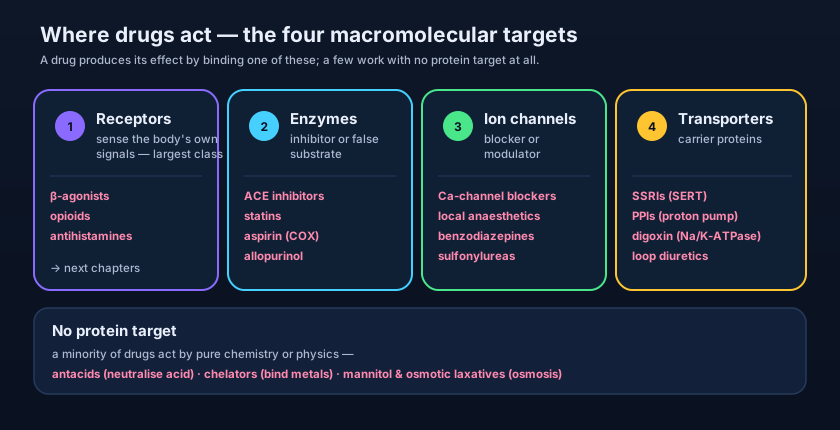
- Almost every drug binds one of four protein targets: receptor, enzyme, ion channel, or transporter.
- Receptors sense endogenous ligands (agonist/antagonist); the other three do a job drugs mostly inhibit.
- ACE inhibitors/statins/NSAIDs (enzymes), CCBs/anaesthetics/benzodiazepines (channels), SSRIs/PPIs/diuretics (transporters).
- A few drugs use no protein target (antacids, chelators, mannitol); and selectivity (where) ≠ specificity (what).
- Katzung BG. Basic & Clinical Pharmacology — Drug receptors & pharmacodynamics; molecular targets of drug action.
- Rang HP, Dale MM, et al. Rang & Dale's Pharmacology — How drugs act: targets (receptors, enzymes, ion channels, transporters).
- Whalen K. Lippincott Illustrated Reviews: Pharmacology — Drug-receptor interactions & mechanisms of drug action.
- Brunton LL, et al. Goodman & Gilman's The Pharmacological Basis of Therapeutics — Pharmacodynamics: molecular mechanisms of drug action.
- Ritter JM, et al. Rang & Dale's Pharmacology — Selectivity vs specificity of drug action.