
What Is Pharmacodynamics? What the Drug Does to the Body
You already know how a drug travels through the body — absorbed, distributed, metabolized, cleared. But none of that explains WHY it heals. A tablet doesn't cure by being present; it cures by grabbing a specific molecule and changing what that molecule does. This is pharmacodynamics — the second half of every drug's story, and the half that explains both the benefit you want and the side effect you don't.
A 7-year-old sits on the exam-room bed, shoulders hunched, fighting for each breath — an acute asthma attack. Her chest whistles on every exhale. The doctor shakes a small inhaler, fits a spacer, and has her take two puffs of salbutamol. Within a couple of minutes the whistling softens, her shoulders drop, and the terrified look fades. Nothing was injected, nothing was cut. A few micrograms of a molecule reached the muscle wrapped around her airways and told it to let go. That instruction — molecule to receptor to relaxed muscle to an open airway — is pharmacodynamics happening in real time.
Two halves of one story: PK and PD
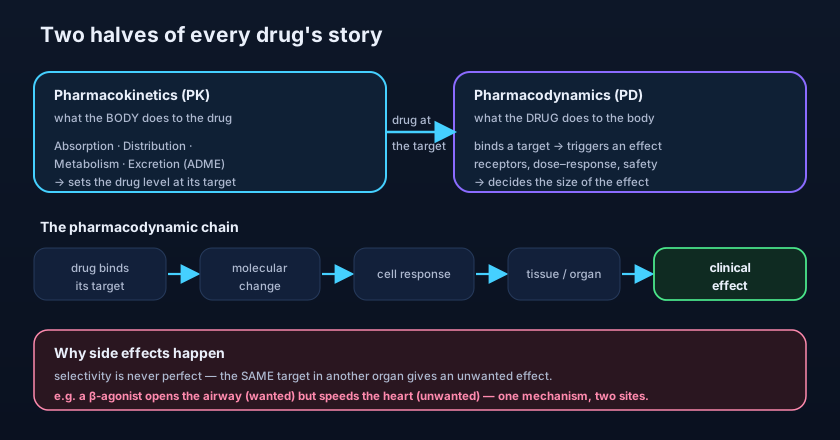
Every drug's life has two chapters, and students constantly mix them up. Pharmacokinetics (PK) is what the BODY does to the drug — absorption, distribution, metabolism and excretion (ADME), the journey you studied in the earlier chapters of this same Principles of Pharmacology box. Pharmacodynamics (PD) is the mirror image: what the DRUG does to the body. PK gets the drug to the scene; PD is the action once it arrives. One sentence to carry forever: PK is the drug's journey, PD is the drug's job.
Think of a letter and its message. Pharmacokinetics is the postal system: how the envelope is picked up, routed, delayed, and eventually delivered or lost. Pharmacodynamics is what happens when the recipient opens the letter and reads it — the reaction it provokes. A perfectly delivered envelope with no message inside does nothing; and the most powerful message never delivered does nothing either. A drug needs both halves to work.
The chain of action: from one molecule to the whole body
A clinical effect is never a single event — it is a cascade. Once pharmacokinetics has delivered the drug to its site of action, pharmacodynamics unfolds in an ordered chain. The drug binds a specific target molecule (usually a protein). That binding triggers a molecular change — a channel opens, an enzyme is blocked, a signalling cascade fires. The molecular change becomes a cellular response — the cell contracts, secretes, or falls silent. Cells acting together produce a tissue effect, and the tissue effect scales up into the whole-body clinical result you can measure: a lower blood pressure, an open airway, a relieved pain.
Notice how tiny the trigger is compared with the result: micrograms of drug, a single class of receptor, yet a life-saving change in a whole organ. That amplification is the signature of receptor pharmacology — one binding event opens a cascade that multiplies its own signal. It is also why a very small dose of the right drug can outperform a large dose of the wrong one: potency lives in the target, not in the quantity.
- PK = what the body does to the drug (ADME); PD = what the drug does to the body.
- PD unfolds as a chain: bind target → molecular change → cellular → tissue → clinical effect.
- Most drugs act by binding a specific target macromolecule, usually a protein.
- Receptor signalling amplifies a tiny input into a large, measurable response.
- PK and PD together — not either alone — decide the right dose and timing.
The magic bullet: targets and the dream of selectivity
Why does a drug touch one tissue and seem to ignore the rest? More than a century ago Paul Ehrlich imagined a "magic bullet" (Zauberkugel) — a substance that would seek out one specific target in the body and strike only it, sparing everything else. That dream became the organizing idea of modern pharmacology: a drug is selective because it fits one particular target molecule the way a key fits one lock. Salbutamol was designed to prefer the β2 receptor; a chemotherapy agent is aimed at a molecule the tumour depends on. Selectivity is what separates a medicine from a poison.
But here is the hard truth the magic-bullet story hides: selectivity is never perfect. The same target molecule usually exists in more than one place in the body. A receptor that produces the healing effect in one organ often sits, unchanged, in another organ where you never wanted the drug to act. The drug cannot tell the two apart — a key opens every matching lock in the house, not only the one you meant. So the drug does its intended job in the target tissue AND an unintended job everywhere else the same target lives.
This is the single most useful idea in all of pharmacodynamics: most side effects are not a separate mystery — they are the SAME mechanism, acting in the wrong place. Back to the inhaler: salbutamol's β2 receptors also live on skeletal muscle and, in smaller numbers, the heart. The very same activation that relaxed the airway causes the familiar fine tremor and a faster heartbeat. The "side effect" is just the on-target action, off-site.
Propranolol is a non-selective β-blocker: it blocks β1 receptors in the heart and β2 receptors in the bronchi. Blocking β1 in the heart is the therapeutic goal — it slows the rate and eases the workload in angina, hypertension and arrhythmias. But the SAME molecule blocks β2 in the airways, and in a person with asthma that removes the very relaxation salbutamol provides — it can trigger dangerous bronchospasm. One drug, one imperfect selectivity, delivering both the benefit and the harm through the identical mechanism at two sites. (You will meet these adrenergic receptors again in the Autonomic Nervous System section.)
- Ehrlich's "magic bullet": a drug that hits one target and spares the rest — the ideal.
- Selectivity comes from a drug fitting one target like a key fits a lock.
- Selectivity is never perfect: the same target usually exists in several tissues.
- Most side effects = the intended mechanism acting at an unintended site.
- The more selective the drug, the fewer off-target effects — but rarely zero.
- Swapping PK and PD. A rule that fixes it: PK = kinetics = the drug MOVING (ADME); PD = dynamics = the drug ACTING. If it's about blood levels and clearance it's PK; if it's about receptors and effect it's PD.
- Believing "more target bound always means more effect". The response often plateaus — once the targets are occupied or the downstream system is saturated, extra drug adds toxicity, not benefit. Effect is not a straight line.
- Treating side effects as random and separate from the mechanism. Usually they ARE the mechanism — the same target activated somewhere you didn't intend.
- Pharmacodynamics is what the drug does to the body — the partner of pharmacokinetics (what the body does to the drug).
- Action runs as a chain: bind a target molecule → molecular change → cellular → tissue → whole-body clinical effect.
- Drugs are selective because they fit a specific target — Ehrlich's magic bullet — but selectivity is never perfect.
- The same target elsewhere in the body turns the intended mechanism into a side effect.
- This article is the doorway to the Pharmacodynamics chapters ahead: targets, receptors and dose–response.
- Katzung BG. Basic & Clinical Pharmacology — Introduction: The Nature of Drugs & Drug Development; drug receptors and pharmacodynamics.
- Rang HP, Dale MM, et al. Rang & Dale's Pharmacology — How drugs act: general principles; molecular targets and selectivity.
- Brunton LL, et al. Goodman & Gilman's The Pharmacological Basis of Therapeutics — Pharmacodynamics: molecular mechanisms of drug action.
- Whalen K. Lippincott Illustrated Reviews: Pharmacology — Pharmacodynamics and drug–receptor interactions.
- Ehrlich P. Historical concept of the 'magic bullet' (Zauberkugel) and selective toxicity.