
PK Meets PD: The Time Course of a Drug's Effect
You have followed a drug through absorption, distribution, metabolism and elimination — that is pharmacokinetics (PK): what the body does to the drug. You have watched it bind receptors and produce a response — that is pharmacodynamics (PD): what the drug does to the body. This chapter is where the two finally meet, on the axis they share: TIME. When does the effect start, peak and fade? Does it rise and fall with the blood level — or can a drug be long gone from the blood and still working a week later? Aspirin will show you the strangest answer.
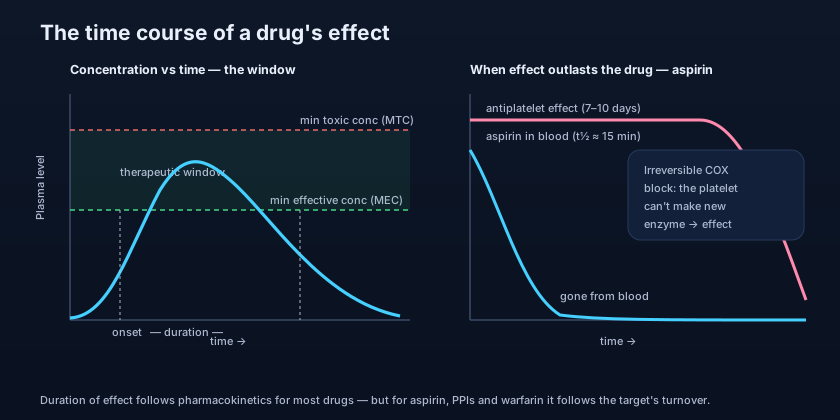
A man swallows a single low-dose aspirin at breakfast. By lunchtime the drug is essentially gone from his blood — aspirin's own molecules have a half-life of only about 15–20 minutes; the plasma is nearly clean by afternoon. Yet if you tested his platelets that evening, tomorrow, and every day for the next week, they would still be switched off — unable to clump, unable to form a clot. The drug is long gone. The effect stays for the life of the platelet, seven to ten days. How can a molecule keep working days after the body has cleared it? That paradox is the whole point of this chapter: the blood level and the effect are two different curves — and sometimes they part ways completely.
Two curves, not one: concentration and effect over time
Draw the plasma concentration of a drug against time and you get a familiar hill. It rises as the drug is absorbed, reaches a peak (Cmax at the time Tmax), then falls as distribution and elimination take over. Now draw the EFFECT on the same time axis. It has its own three landmarks: onset (when the response first appears), peak effect, and duration (how long it lasts). The instinct is to assume the two curves are the same shape stacked on top of each other. They are not. The effect curve is usually shifted and stretched relative to the concentration curve — most importantly, the effect lags behind the level.
Hysteresis: why the effect lags the level
The receptors that produce a drug's effect are almost never floating in the plasma. They sit at the site of action — the biophase, or effect compartment — inside the brain, the heart muscle, a tumour. The plasma is only the highway; the drug must still leave it and distribute into that tissue before it can act. That transit takes time, so the concentration at the effect site rises and falls AFTER the plasma concentration does. Add the downstream steps — a receptor triggers a second messenger, which drives an enzyme, which changes a physiological variable — and the response lags even further. The result is hysteresis: at the same plasma concentration you can see a different effect depending on whether the level is rising or falling. The two curves are not superimposable.
Digoxin is the classic teaching case: after an intravenous dose the plasma level is HIGHEST in the first hour, while the drug is still redistributing into cardiac tissue — yet its therapeutic effect on the heart is not maximal then. This is exactly why a digoxin blood level drawn too early (before ~6 hours) reads misleadingly high and does not reflect the effect. Sample after distribution is complete, when plasma and tissue have equilibrated.
- Concentration has three landmarks: rise, peak (Cmax/Tmax), fall.
- Effect has its own three: onset, peak effect, duration.
- The effect usually LAGS the plasma level — this is hysteresis.
- The lag comes from distribution to the effect site (biophase) plus downstream steps.
- Concentration and effect curves are NOT superimposable.
The therapeutic window in time: MEC, MTC and the dosing interval
Overlay two horizontal lines on the concentration-time curve and dosing suddenly makes sense. The lower line is the minimum effective concentration (MEC): below it the drug does too little. The upper line is the minimum toxic concentration (MTC): above it toxicity appears. The band between them is the therapeutic window. The whole art of dosing is to keep the patient's concentration inside that band over time — high enough to work, low enough to be safe. The onset of effect is the moment the rising curve first crosses the MEC; the duration is how long it stays above the MEC; the danger begins if the peak pokes above the MTC. Give too little and you never cross the MEC; give too much or too fast and you breach the MTC.
This band is where PK and PD literally overlap on one graph, and it explains the dosing interval. We repeat doses so that each new dose lifts the level before the previous one falls below the MEC — the troughs stay effective and the peaks stay safe. How wide the spacing can be is set by the drug's half-life: a short half-life empties the window fast and demands frequent dosing (or a sustained-release form), while a long half-life lets the level coast between doses. The narrower the therapeutic window, the more carefully this must be tuned — the origin of therapeutic drug monitoring for drugs like digoxin, lithium, and aminoglycosides.
Everything about half-life, steady state, and how repeated doses stack toward a plateau lives in the Kinetics & Dosing (PK) chapters of this course. The one-line link: it takes about 4–5 half-lives to reach steady state on a fixed regimen — and the same 4–5 half-lives to wash out after stopping. This chapter simply adds the missing axis to those ideas: not just how high the level sits, but WHEN the effect follows.
The loading dose: buying time to reach effect fast
If a drug needs 4–5 half-lives to reach a working steady state, a long half-life is a problem when you need the effect NOW. A drug with a 24-hour half-life would take days on a maintenance dose alone before the level climbs into the therapeutic window. The solution is a loading dose: a larger up-front dose that fills the volume of distribution immediately and lifts the concentration into the window in one step. After that, smaller maintenance doses simply replace what is eliminated each interval, holding the level steady. The loading dose sets WHERE you start; the maintenance dose sets where you STAY. Note that a loading dose depends on the volume of distribution, while the maintenance dose depends on clearance — two PK parameters from the earlier chapters doing PD work here.
Amiodarone, with a half-life of weeks, is loaded heavily for days before dropping to maintenance — without loading you would wait months for effect. Digoxin and many antibiotics are loaded for the same reason. The mirror image is also true: a drug with a long half-life is slow to leave, so its effect (and any toxicity) also lingers long after you stop — offset lags just as onset did.
- MEC = floor of effect; MTC = ceiling of safety; the gap is the therapeutic window.
- Onset = curve crosses MEC; duration = time spent above MEC; toxicity = peak above MTC.
- Half-life sets the dosing interval; ~4–5 half-lives reach (or wash out) steady state.
- Loading dose fills Vd to reach effect fast; maintenance dose replaces clearance.
- A long half-life means slow onset AND slow offset — the effect lingers after stopping.
The PD twist: when the effect outlasts the drug
For most drugs, duration of effect tracks the plasma level — as the drug is cleared, the effect fades. But for an important minority, the two decouple completely: the drug vanishes from the blood while the effect marches on for days. This happens for two reasons, and recognizing them is what separates a mechanistic understanding from rote memorizing of durations. The first is irreversible binding; the second is slow downstream turnover. In both, PK no longer governs the offset — PD does.
Irreversible binding: the drug leaves a permanent mark. If a drug binds its target covalently, the target is disabled for good; recovery must wait for the cell to SYNTHESIZE fresh target protein, no matter how fast the drug itself is cleared. Aspirin is the perfect example: it irreversibly acetylates cyclo-oxygenase (COX) inside platelets. A platelet has no nucleus and cannot make new enzyme, so once its COX is acetylated it is disabled for the platelet's entire lifespan — 7 to 10 days — even though aspirin's own half-life is minutes. Effect duration here is set by platelet turnover (about 10% replaced per day), not by the drug's PK at all.
Proton-pump inhibitors (omeprazole and its family) have a plasma half-life of only 1–2 hours, yet are dosed once daily — because they irreversibly block the gastric proton pump, and acid suppression lasts until new pump protein is made (24–48 hours). MAO inhibitors irreversibly inactivate monoamine oxidase, so their effect (and drug/food interaction risk) persists for up to two weeks after stopping, until new enzyme is synthesized. In every case: short PK, long PD.
Slow downstream turnover: the drug acts on a slow-moving pool. The second mechanism is subtler. Warfarin blocks the synthesis of vitamin-K-dependent clotting factors, but it does nothing to the factors ALREADY circulating. Those must decay on their own slow schedule (factor II's half-life is ~60 hours). So even when warfarin reaches a steady blood level within a day, its anticoagulant effect takes several days to appear — the onset lags by the turnover of the clotting factors, not by the drug's PK. The same slowness governs the offset: stop warfarin and coagulation does not normalize for days, because the depleted factors must be re-synthesized. Here the effect follows the biology of the factor pool, and the drug level is almost a bystander.
This delayed onset has a life-or-death clinical consequence. When you must anticoagulate a patient urgently, you cannot wait days for warfarin to work — so you bridge with heparin, which acts within minutes, and continue it until warfarin's effect has caught up (usually a few days, guided by the INR). Worse, warfarin transiently lowers proteins C and S (natural anticoagulants) even faster than it lowers the clotting factors, so the very first days can be briefly pro-clotting — another reason the fast-acting bridge is essential. You will meet warfarin bridging again in the Cardiovascular chapters on anticoagulation.
Contrast these with a drug whose effect faithfully tracks its level. A short-acting benzodiazepine like midazolam is the counter-example: it binds its receptor reversibly, has no slow downstream pool, and so its sedative effect rises and falls almost in lockstep with the plasma level. As the drug redistributes and is cleared, the patient wakes — offset is governed by PK, exactly as intuition expects. Put the two side by side and the lesson is sharp: for reversible, direct-acting drugs, PK predicts the effect's time course; for irreversible or turnover-limited drugs, you must think in PD. Ask, every time: is this effect limited by the drug leaving — or by the body rebuilding what the drug changed?
- For most drugs, duration of effect follows the plasma level (PK-governed).
- Irreversible binding: effect lasts until the target is re-synthesized (aspirin, PPIs, MAOIs).
- Aspirin's antiplatelet effect = platelet lifespan (7–10 days), not its minutes-long half-life.
- Slow turnover: warfarin's onset and offset follow clotting-factor decay, lagging by days.
- Reversible, direct drugs (e.g. midazolam) track their level closely — PK predicts effect.
- Always ask: is offset limited by drug leaving, or by the body rebuilding?
- Assuming a drug's DURATION of effect always equals its plasma half-life. True for reversible drugs, false for irreversible (aspirin, PPIs) and turnover-limited (warfarin) ones.
- Expecting warfarin to anticoagulate immediately. Its onset lags by days (clotting-factor turnover) — hence the heparin bridge.
- Forgetting hysteresis — reading a blood level (e.g. digoxin) too early, before drug and effect-site have equilibrated, and misjudging the effect.
- Treating concentration and effect as one superimposable curve. They share a time axis but not a shape.
A single low-dose aspirin is cleared from the plasma within a few hours, yet its antiplatelet effect lasts 7–10 days. The best explanation is that aspirin:
- Concentration and effect are two curves on one time axis; the effect usually lags (hysteresis) because the drug must reach the effect site.
- MEC and MTC bound the therapeutic window in time; half-life sets the dosing interval, and a loading dose reaches effect fast.
- For most drugs PK governs duration — but irreversible binders (aspirin, PPIs, MAOIs) act until the target is remade.
- Warfarin's effect follows clotting-factor turnover, so onset and offset lag by days — the reason for heparin bridging.
- PK gets the drug there, PD decides what it does, and TIME is where the two meet.
- Rang HP, Dale MM, et al. Rang & Dale's Pharmacology — Pharmacokinetics/pharmacodynamics: time course of drug effect, effect compartment & irreversible action.
- Katzung BG. Basic & Clinical Pharmacology — Pharmacodynamics: time course of drug effect, therapeutic window, loading & maintenance doses.
- Brunton LL, et al. Goodman & Gilman's The Pharmacological Basis of Therapeutics — Relationship between drug concentration and response; aspirin, PPIs & warfarin kinetics of effect.
- Whalen K. Lippincott Illustrated Reviews: Pharmacology — Minimum effective concentration, therapeutic window & duration of action.
- Hilal-Dandan R, Brunton LL. Goodman & Gilman's Manual of Pharmacology and Therapeutics — Antiplatelet aspirin & warfarin onset/offset.

