
Affinity, Efficacy and Potency: Three Words Students Always Confuse
A patient asks for the "strongest" painkiller. Behind that one word hide three different ideas that decide everything a drug does: whether it even binds its receptor, what it does once bound, and how many milligrams you need. Mix them up and you will believe a microgram of fentanyl is somehow "better" than a milligram of morphine, or that the 10 mg tablet beats the 40 mg one. Untangle affinity, efficacy and potency and you can read any dose–response curve — and any drug advert — without being fooled.
A woman leans over the pharmacy counter and lowers her voice: "Just give me the STRONGEST painkiller you have." It sounds like a single request, but the pharmacist hears three separate questions hiding inside the word "strongest". Does she mean the drug that needs the fewest milligrams? The one that can push the pain down the furthest? Or simply the one most likely to work at all? Fentanyl is dosed in micrograms and morphine in milligrams — yet at their ceilings they relieve pain about equally. Meanwhile paracetamol will never reach an opioid's ceiling no matter how much she takes. "Strongest" is not one property. It is three — and telling them apart is the whole of this lesson.
Affinity: does the drug bind at all?
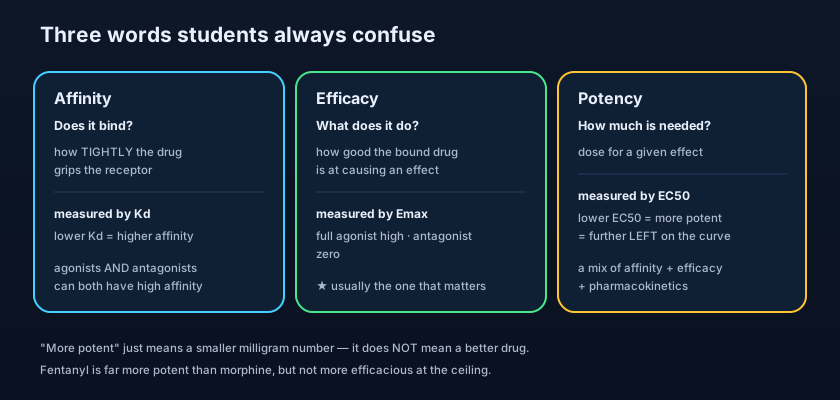
Affinity is how TIGHTLY a drug grips its receptor. Before a drug can do anything, it must first attach to its receptor — and affinity measures how eagerly and how firmly it does so. It governs occupancy: at a given concentration, a high-affinity drug fills more of the receptors than a low-affinity one. We put a number on it with the dissociation constant, Kd — the concentration at which half the receptors are occupied. The trick to remember is that Kd runs backwards: a LOW Kd means the drug binds at very low concentrations, so LOW Kd = HIGH affinity. Affinity answers only the first question — IF the drug binds — and says nothing yet about what happens next.
Here is the point students miss: BOTH agonists and antagonists can have high affinity. A blocker has to grab the receptor tightly to keep the agonist out — indeed some of the most powerful antagonists are the ones with the highest affinity of all. So affinity alone tells you nothing about whether a drug switches the receptor ON or simply sits in the doorway. Binding and acting are two separate steps.
Naloxone, the opioid-overdose antidote, has very HIGH affinity for the μ-opioid receptor yet ZERO efficacy. That combination is exactly what makes it work: it out-competes morphine or heroin for the receptor (high affinity) and then does nothing (no efficacy), kicking the opioid off and reversing the overdose in seconds. High affinity, zero efficacy — a life-saving pair.
Efficacy: what does it do once bound?
Efficacy is how GOOD the bound drug is at producing an effect. Once a drug is on the receptor, efficacy (its intrinsic activity) decides how strongly it activates it. This is the property that separates the drug families. A full agonist has high efficacy: it flips the receptor fully ON and can drive the tissue to its maximal response. A partial agonist has intermediate efficacy: even when it occupies every receptor, it produces only a submaximal effect — it can never push all the way. An antagonist has ZERO efficacy: it binds (it may have excellent affinity) but does not activate the receptor at all; it simply denies the seat to something that would. Efficacy answers the second question — WHAT the drug does after it binds.
Emax is efficacy made visible. On a dose–response curve, efficacy shows itself as Emax — the maximal effect a drug can produce no matter how high you push the dose. Emax is the drug's clinical ceiling: the most help it can ever give a patient. A full agonist has a tall Emax; a partial agonist's curve plateaus lower even at full occupancy; an antagonist alone produces no effect at all. When we compare drugs by their ceiling, we are comparing efficacy — and that ceiling is usually what decides whether a drug is clinically worth having.
- Affinity = how tightly a drug binds; measured by Kd (LOW Kd = HIGH affinity).
- Affinity governs occupancy and answers only IF the drug binds.
- Both agonists AND antagonists can have high affinity.
- Efficacy = how good the bound drug is at activating the receptor; answers WHAT it does.
- Full agonist = high efficacy; partial = intermediate; antagonist = ZERO efficacy.
- Emax (the maximal effect) is efficacy read off the curve — the drug's clinical ceiling.
Potency: how much drug do you need?
Potency is how MUCH drug it takes to reach a given effect. Potency is not about how big an effect a drug can produce — it is about how little of it you need to produce a standard effect. We measure it with the EC50: the concentration that gives half of that drug's own maximal effect. A more potent drug has a LOWER EC50 — it does the job at a smaller concentration. On a log dose–response curve, higher potency simply shifts the curve to the LEFT (the same S-shape, just slid leftward). Potency answers the third, and clinically least important, question: how many milligrams?
Crucially, potency is a COMPOSITE — it is not a fundamental property of its own. It blends affinity (how well the drug binds), efficacy (how well the bound drug works), and, in a living patient, pharmacokinetics (how much of the dose actually reaches the receptor after absorption, distribution and metabolism). That is why potency can differ wildly between two drugs that are otherwise clinically interchangeable — and why the milligram number on a box tells you almost nothing about how good the drug is.
The single sentence to carry out of this lesson: efficacy matters far more than potency. Potency only sets the milligram number on the label — a more potent drug just means a smaller number, easily fixed by giving a bit more. Efficacy (Emax) sets the ceiling of how much you can actually help the patient, and no dose can raise it. "More potent" is a marketing word; "more efficacious" is a clinical one.
A loop diuretic like furosemide and a thiazide differ in EFFICACY, not just potency — and here the difference is genuinely clinical. Furosemide has a much higher Emax: it can force a far larger maximal diuresis, which is why it (not a thiazide) is the drug for acute pulmonary oedema. A thiazide's ceiling is lower; pushing its dose up never matches a loop's flood. This is a real superiority of efficacy — the kind that changes which drug saves the patient — not a mere milligram difference.
Rosuvastatin lowers LDL at a smaller milligram dose than atorvastatin — it is more POTENT. But that is a potency comparison, not a verdict on which drug is "better": both are excellent statins, and the potency gap just means the tablets carry different numbers. Judging a drug superior because it works at 10 mg while a rival needs 40 mg is comparing labels, not clinical worth. The right questions are how far each lowers LDL (efficacy) and how each fits the patient — not whose number is smaller.
Fentanyl is roughly a hundred times more POTENT than morphine — it is dosed in micrograms where morphine is dosed in milligrams. But both are full agonists at the μ-receptor with a similarly high efficacy, so at their ceilings they relieve severe pain about equally; fentanyl is not "stronger" at controlling pain, only smaller in dose. Paracetamol, by contrast, differs from an opioid in EFFICACY: its analgesic ceiling is far lower, so no dose of it will ever match an opioid for severe pain. So the woman asking for the "strongest" painkiller needs an efficacy answer, not a potency one.
- Potency = how much drug is needed; measured by EC50 (LOWER EC50 = MORE potent).
- Higher potency shifts the log dose–response curve to the LEFT.
- Potency is a COMPOSITE of affinity + efficacy + (in vivo) pharmacokinetics.
- "More potent" usually just means a smaller milligram number — not a better drug.
- Efficacy (Emax) is the clinical ceiling; it limits how much you can help the patient.
- When drugs truly differ (loop vs thiazide), it is usually efficacy that matters.
- Equating potency with clinical superiority. A lower EC50 means a smaller dose, not a better outcome; efficacy (Emax) decides how much you can help.
- The "10 mg drug beats the 40 mg drug" marketing fallacy. A smaller milligram number is a potency difference, corrected by simply dosing higher — not proof of a superior drug.
- Thinking a high-affinity antagonist has some "efficacy". Its efficacy is exactly ZERO — it binds tightly and does nothing; that is the whole point of a blocker.
- Confusing affinity with efficacy. Affinity says IF a drug binds; efficacy says WHAT it does once bound — a drug can have huge affinity and zero efficacy (naloxone).
A new drug reaches half its maximal effect at a much lower concentration than an old drug, but both curves plateau at the same height. The new drug is:
- Affinity = IF it binds (Kd; low Kd = high affinity); both agonists and antagonists can bind tightly.
- Efficacy = WHAT it does once bound; full agonist high, partial intermediate, antagonist zero.
- Emax is efficacy on the curve — the clinical ceiling of how much you can help.
- Potency = HOW MUCH is needed (EC50); a composite of affinity + efficacy + pharmacokinetics.
- Efficacy beats potency: "more potent" is usually just a smaller milligram number, not a better drug.
- Rang HP, Dale MM, et al. Rang & Dale's Pharmacology — Drug–receptor interactions: affinity, efficacy, agonists, antagonists & potency.
- Katzung BG. Basic & Clinical Pharmacology — Drug receptors & pharmacodynamics: graded dose–response, EC50, Emax & potency.
- Whalen K. Lippincott Illustrated Reviews: Pharmacology — Dose–response relationships: potency vs efficacy.
- Brunton LL, et al. Goodman & Gilman's The Pharmacological Basis of Therapeutics — Pharmacodynamics: receptor binding, intrinsic activity & Kd.
- Bertram G. Katzung & Trevor's Pharmacology Examination & Board Review — Potency vs efficacy worked comparisons.