
Agonists, Partial Agonists and Antagonists: The Efficacy Spectrum
Two drugs can both grip the same receptor and yet do opposite things — one switches the cell full on, the other jams the lock so nothing else can. Between them sits a stranger drug that turns the cell only halfway on and, in the wrong company, actually turns it down. Binding is only half the story; what a drug DOES once bound — its efficacy — is what separates a painkiller from an antidote. This is the spectrum that makes pharmacology click.
Paramedics kneel over a man who has stopped breathing after a heroin overdose — a full agonist has slammed his µ-opioid receptors and shut down the drive to breathe. One drug can reverse it in seconds: naloxone, which occupies the same receptors but does nothing itself, kicking the heroin off. Now shift the scene. The next day, a clinic starts that same man on buprenorphine — a PARTIAL agonist — for opioid-use disorder. It calms his craving with a built-in ceiling that makes fatal respiratory depression far less likely. Yet if they had given it while heroin still filled his receptors, it would have thrown him into violent withdrawal — behaving, in that moment, as an antagonist. One molecule, two faces. To understand how that is possible, we need the efficacy spectrum.
Two properties, not one: affinity and efficacy
Every drug–receptor story has two separate questions. First: does the drug bind? That is affinity — how tightly it grabs the receptor. Second, and independently: once bound, does it activate the receptor? That is efficacy (also called intrinsic activity). A drug can have high affinity and zero efficacy — it holds on tight but does nothing. The entire agonist–antagonist spectrum is just different combinations of these two. Keep them apart in your mind and the confusion dissolves.
Intrinsic activity is put on a scale. Give the maximal tissue response a value of +1 and no effect a value of 0, and every drug falls somewhere on that line — or, at the strange far end, below zero. That single number, from +1 through 0 to negative, defines what kind of drug you are holding.
The full agonist: intrinsic activity = 1
A full agonist is the drug you picture when you hear "it works". It binds AND produces the maximal response the tissue can give — intrinsic activity = 1. With enough of it, the receptor system is driven all the way. Morphine at the µ-opioid receptor, adrenaline at adrenoceptors, salbutamol at the β2 receptor of airway smooth muscle: each pushes the effector to its full ceiling. Give more and the curve plateaus not because the drug ran out of push, but because the tissue ran out of response to give.
The partial agonist: bound to a lower ceiling
Here is where students slow down — so go carefully. A partial agonist binds and activates the receptor, but even when it occupies 100% of the receptors it produces only a SUB-maximal response — its intrinsic activity sits strictly between 0 and 1. It has a built-in ceiling that no dose can lift. This is not weakness or a small dose; it is a fixed property of the molecule. Buprenorphine (opioid), aripiprazole (dopamine D2), pindolol (a β-blocker with intrinsic sympathomimetic activity), varenicline (nicotinic, for smoking cessation) and buspirone (5-HT1A) are all partial agonists — each activates its receptor part-way and then stops climbing.
Now the twist that makes partial agonists clinically powerful. In the presence of a full agonist, a partial agonist behaves as an ANTAGONIST. Picture a receptor pool already fully driven by a strong full agonist. Add a partial agonist and it competes for those receptors — but every receptor it captures now delivers LESS effect than the full agonist would have. The net response falls. So the same drug adds effect to an empty system yet subtracts effect from a maximally driven one. This dual personality — agonist when alone, antagonist against a full agonist — is exactly why buprenorphine can precipitate withdrawal in someone saturated with heroin.
The partial agonist's ceiling is a safety feature. Because buprenorphine cannot drive the µ-receptor to full effect, its respiratory depression plateaus — a large overdose of buprenorphine alone is far less likely to stop breathing than an equivalent binge of a full agonist like heroin or methadone. That same ceiling is why it is a first-line maintenance drug: it holds craving down without the deep, dose-limitless depression of a full agonist.
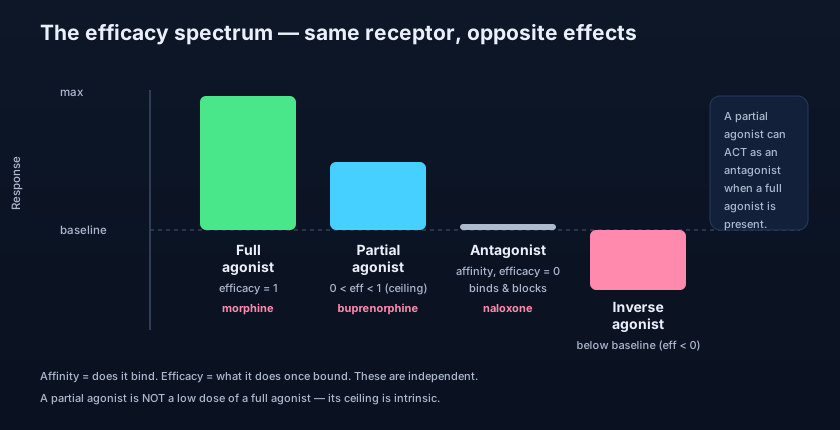
At the µ-opioid receptor: MORPHINE is a full agonist — binds and drives the full response (analgesia, euphoria, and at high dose, respiratory depression). BUPRENORPHINE is a partial agonist — binds with very high affinity but delivers a capped, sub-maximal response, so it treats pain and dependence with a safety ceiling, yet displaces and blocks a full agonist. NALOXONE is a pure antagonist — binds with high affinity, produces zero effect, and by occupying the receptor reverses an overdose. Same lock, three different keys: one turns it fully, one turns it partway, one won't turn at all but blocks every other key.
- Affinity = how well a drug binds; efficacy (intrinsic activity) = what it does once bound. They are independent.
- Full agonist: intrinsic activity = 1; produces the maximal tissue response (morphine, adrenaline, salbutamol).
- Partial agonist: 0 < intrinsic activity < 1; sub-maximal even at full occupancy — a fixed ceiling, not a small dose.
- A partial agonist acts as an ANTAGONIST when a full agonist is present (it competes but delivers less).
- The ceiling gives partial agonists a safety margin — e.g. buprenorphine's capped respiratory depression.
The antagonist: affinity without efficacy
An antagonist is the purest expression of "binds but does nothing". It has affinity but ZERO efficacy (intrinsic activity = 0). It occupies the receptor, produces no response of its own, and — crucially — by sitting there it blocks agonists from binding and acting. Do not mistake this for "doing nothing": blocking is itself a powerful effect. Naloxone reverses opioid overdose, atropine blocks muscarinic receptors to speed a dangerously slow heart, propranolol blocks β-adrenoceptors to slow the heart in angina and hypertension, and losartan blocks the angiotensin AT1 receptor to lower blood pressure. Each does its job precisely by preventing an endogenous or exogenous agonist from acting.
Because the antagonist's whole job is to compete for the receptor and win, the details of HOW it competes — reversibly or irreversibly, at the same site or elsewhere — matter enormously. That mechanics of blocking is a chapter of its own, the different types of antagonism, which we take up next.
The inverse agonist: below the baseline
Some receptors are quietly active even with nothing bound. They have constitutive (baseline) activity — a low level of signalling on their own. A plain antagonist bound to such a receptor holds that baseline steady at zero-change. But an INVERSE AGONIST does more: it binds and pushes the receptor BELOW its baseline, producing the opposite of the constitutive activity — an intrinsic activity less than 0. Many H1 antihistamines behave as inverse agonists at the constitutively active histamine H1 receptor, and β-carbolines act as inverse agonists at the GABA-A benzodiazepine site (causing anxiety and seizures — the mirror image of a benzodiazepine's calm). A subtle but important point: several drugs we casually label "antagonists" are in fact inverse agonists at receptors that have baseline tone.
So the full efficacy spectrum reads, from top to bottom: full agonist (+1) → partial agonist (between 0 and 1) → antagonist (0, holds the baseline) → inverse agonist (below 0, reverses the baseline). One receptor, one binding site, and a whole ladder of possible effects depending on what the bound drug tells the receptor to do.
- Antagonist: affinity + zero efficacy; occupies the receptor and blocks agonists — blocking IS an effect (naloxone, atropine, propranolol, losartan).
- Inverse agonist: intrinsic activity < 0; pushes a constitutively active receptor BELOW its baseline (some H1 antihistamines, β-carbolines at GABA-A).
- Many drugs called "antagonists" are actually inverse agonists at receptors with baseline (constitutive) activity.
- The spectrum runs +1 (full) → 0–1 (partial) → 0 (antagonist) → < 0 (inverse).
- How an antagonist competes (reversible vs irreversible, competitive vs not) is the next chapter: types of antagonism.
- "A partial agonist is just a small dose of a full agonist." Wrong — the ceiling is intrinsic to the molecule. Even at 100% receptor occupancy it cannot reach the full response; no dose lifts the ceiling.
- Confusing an antagonist (zero effect of its own) with an inverse agonist (an opposite, below-baseline effect). Only the inverse agonist actively reverses constitutive activity.
- Thinking an antagonist "does nothing". It blocks the receptor — a decisive clinical effect (that is how naloxone saves a life and propranolol slows a heart).
- Forgetting that a partial agonist flips to acting like an antagonist when a full agonist is already present — the reason buprenorphine can precipitate withdrawal.
A patient saturated with a full µ-opioid agonist (heroin) is given buprenorphine and abruptly goes into withdrawal. This happens because buprenorphine:
- Affinity (does it bind?) and efficacy (does it activate?) are separate; the whole spectrum is combinations of the two.
- Full agonist = intrinsic activity 1 (morphine); partial agonist = between 0 and 1 with a fixed ceiling (buprenorphine) and acts as an antagonist against a full agonist.
- Antagonist = affinity, zero efficacy; blocks agonists (naloxone) — blocking IS an effect. Inverse agonist = below baseline (< 0) at constitutively active receptors.
- The µ-opioid trio (morphine/buprenorphine/naloxone) shows all three faces on one receptor; how blocking works comes next in types of antagonism.
- Rang HP, Dale MM, et al. Rang & Dale's Pharmacology — Drug–receptor interactions: agonists, partial agonists, antagonists, inverse agonists & intrinsic activity.
- Katzung BG. Basic & Clinical Pharmacology — Drug receptors & pharmacodynamics: efficacy, partial agonism & constitutive activity.
- Brunton LL, et al. Goodman & Gilman's The Pharmacological Basis of Therapeutics — Pharmacodynamics: receptors, efficacy & inverse agonism.
- Whalen K. Lippincott Illustrated Reviews: Pharmacology — Agonists, partial agonists & antagonists.
- Rosenbaum SE. Basic Pharmacokinetics and Pharmacodynamics — Intrinsic activity & the efficacy spectrum.