
Receptor Families and How the Signal Gets Inside the Cell
Two drugs, two speeds. A puff of acetylcholine snaps a muscle taut in milliseconds; a dose of steroid takes hours to quiet an inflamed joint. Same body, same idea — a chemical binds a receptor — yet one acts faster than a blink and the other slower than a nap. The secret is that receptors come in exactly four families, and each family has its own speed. Learn the four and you can predict how fast a drug will act before you ever give it.
Picture two patients in the same hour. In the operating theatre, an anaesthetist pushes a muscle relaxant; within seconds the diaphragm falls still and the surgeon can work. Down the corridor, a woman with a flaring autoimmune joint swallows prednisolone — and is told, honestly, that the real relief will build over the next day, not the next minute. Neither drug is 'stronger' than the other. They simply speak to different kinds of receptor, and the kind of receptor decides the speed. That single organising idea — timescale — is the map for this whole article.
Four families, four speeds
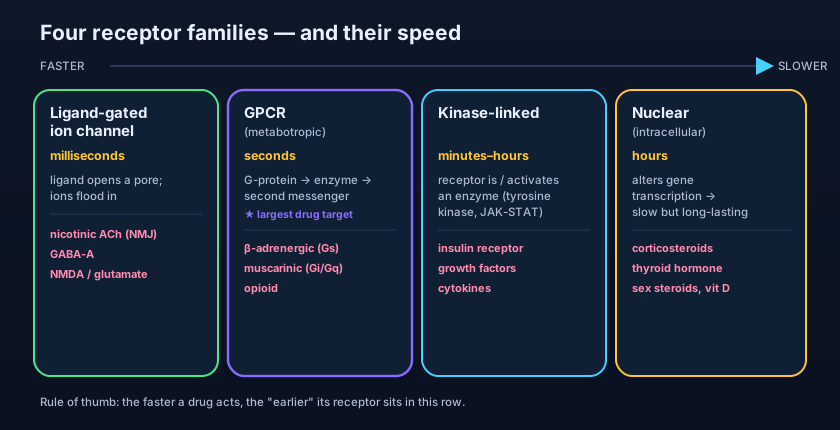
Every drug receptor belongs to one of just four superfamilies. They are (1) ligand-gated ion channels, (2) G-protein-coupled receptors (GPCRs), (3) kinase-linked / enzyme-linked receptors, and (4) nuclear (intracellular) receptors. The elegant part is that they line up in order of speed. An ion channel opens in MILLISECONDS. A GPCR works over SECONDS. A kinase-linked receptor takes MINUTES to HOURS. A nuclear receptor, which must change which genes a cell reads, takes HOURS. Onset of action tracks receptor type almost perfectly — so if you know the family, you can predict the speed, and often the mechanism, before opening any reference.
1. Ligand-gated ion channels — the millisecond switch
These are the fastest receptors in the body. Also called ionotropic receptors, they are a channel and a receptor fused into one protein. The moment the neurotransmitter binds, the channel's gate flicks open and ions pour through — no messengers, no relay, just a direct pore. This is why they carry fast synaptic transmission, where timing is everything. The classic is the nicotinic acetylcholine receptor at the neuromuscular junction (NMJ): acetylcholine lands, Na⁺ rushes in, the muscle fires — all in about a millisecond. The GABA-A receptor is the same design but inhibitory (it lets Cl⁻ in to calm the neuron) and is the target of the benzodiazepines that sedate and stop seizures. The NMDA and other glutamate receptors are the excitatory partners central to learning and, when overactive, to excitotoxicity.
2. G-protein-coupled receptors — seconds, and the biggest drug target of all
If ion channels are a light switch, GPCRs are a relay team. A GPCR (also called metabotropic, because it acts through metabolism/messengers, not a direct pore) sits in the membrane, snakes through it seven times, and does not itself let ions through. When an agonist binds, the receptor nudges an attached G-protein inside the cell, and the G-protein splits off to switch on an enzyme that makes a second messenger. There are three workhorse G-proteins to know: Gs stimulates adenylyl cyclase to RAISE cAMP; Gi inhibits adenylyl cyclase to LOWER cAMP; and Gq activates phospholipase C, splitting a membrane lipid into IP₃ and DAG, which together release intracellular Ca²⁺. Because this covers so many hormones and neurotransmitters, GPCRs are the LARGEST class of drug targets — a large share of all prescribed medicines act on them. Examples: the β-adrenergic receptor (Gs), the M2 muscarinic receptor of the heart (Gi, slowing it), the α1-adrenergic receptor of blood vessels (Gq, constricting them), and the opioid receptors.
One number worth remembering: GPCRs are the target of roughly a third of all approved drugs. When you later study the autonomic nervous system, nearly every β-blocker, muscarinic agent and α-blocker is really just a GPCR story — the same Gs/Gi/Gq logic, reused organ after organ. Master the three G-proteins once and dozens of drugs become predictable.
3. Kinase-linked / enzyme-linked receptors — minutes to hours
Here the receptor itself is (or recruits) an enzyme. These are large surface receptors, typically for hormones and growth factors that regulate cell growth, metabolism and immunity. When the ligand binds, two receptor molecules pair up and their intracellular tails switch on a kinase — an enzyme that tags proteins with phosphate — kicking off a signalling cascade that ends by changing which genes and proteins the cell makes. The receptor tyrosine kinases (RTKs) do this directly; the insulin receptor is the textbook example, and the receptors for growth factors like EGF work the same way. Cytokine receptors have no built-in kinase, so they borrow one: they recruit JAK enzymes that activate STAT proteins (the JAK-STAT pathway). Because they rewire the cell rather than flip a channel, they act over minutes to hours.
This family is where much of modern targeted therapy lives. Trastuzumab is a monoclonal antibody that blocks the HER2 receptor tyrosine kinase over-expressed in some breast cancers, starving the tumour of its growth signal. The '-nib' small molecules (imatinib, gefitinib) plug tyrosine kinases directly. And the JAK inhibitors ('-tinib' drugs like tofacitinib) shut down the JAK-STAT pathway to calm autoimmune disease. All work on the slow, growth-and-immunity receptors — which is exactly why their benefits build over days and weeks, not seconds.
4. Nuclear (intracellular) receptors — the hours-long rewrite
These receptors are not on the cell surface at all. They float inside the cell. Only fat-soluble (lipophilic) messengers that can slip through the cell membrane reach them — which is precisely why steroid and thyroid hormones are lipid-based. Once bound, the receptor–hormone complex travels to the nucleus, latches onto DNA, and turns specific genes up or down, changing which proteins the cell builds. That is a slow business: transcription and translation take HOURS to change the cell's protein makeup, so the onset is slow — but because you have altered the cell's machinery, the effect is long-lasting and outlives the drug in the blood. The examples are the classic slow-acting agents: corticosteroids, thyroid hormone, the sex steroids (oestrogen, testosterone), vitamin D and the retinoids.
- Four superfamilies: ion channels, GPCRs, kinase-linked, and nuclear receptors.
- Onset tracks type: ion channels = ms, GPCRs = seconds, kinase = min–hours, nuclear = hours.
- Only ligand-gated channels move ions directly; GPCRs act via second messengers (cAMP, IP₃/DAG, Ca²⁺).
- GPCRs are the single largest class of drug targets — about a third of all drugs.
- Nuclear receptors are intracellular and need lipophilic ligands (steroids, thyroid) — slow on, long lasting.
- Assuming all receptors sit on the cell surface. Nuclear/intracellular receptors are inside the cell — that is why steroids must be lipophilic to reach them.
- Confusing ionotropic with metabotropic. Ionotropic = the receptor IS the channel (direct, ms); metabotropic (GPCR) = works through a G-protein and messengers (indirect, seconds).
- Expecting steroids to work instantly. Because they act by changing gene transcription, their effect builds over hours — never judge a steroid by the first few minutes.
- Thinking a slower receptor means a weaker drug. Speed and strength are unrelated — a nuclear receptor drug can be profoundly powerful, just slow to start.
A drug's therapeutic effect appears only after several hours and then lasts a long time. Which receptor family is it most likely acting on?
- There are four receptor superfamilies, and they line up by speed.
- Ligand-gated ion channels act in milliseconds (nicotinic, GABA-A, NMDA) — fast synaptic transmission.
- GPCRs act in seconds via Gs/Gi/Gq and second messengers, and are the largest drug-target class.
- Kinase-linked receptors act over minutes–hours (insulin, HER2/trastuzumab, JAK-STAT); nuclear receptors over hours (steroids, thyroid) — slow on, long lasting.
- Rang HP, Dale MM, et al. Rang & Dale's Pharmacology — How drugs act: molecular aspects; the four receptor superfamilies & signal transduction.
- Katzung BG. Basic & Clinical Pharmacology — Drug Receptors & Pharmacodynamics: receptor types and signalling mechanisms.
- Brunton LL, et al. Goodman & Gilman's The Pharmacological Basis of Therapeutics — Molecular mechanisms of drug action & receptor signalling.
- Whalen K. Lippincott Illustrated Reviews: Pharmacology — Signal transduction & receptor families.
- Alberts B, et al. Molecular Biology of the Cell — Cell signalling: ion-channel-coupled, GPCR, enzyme-coupled & nuclear receptors.