
Second Messengers and Signal Amplification: How a Whisper Becomes a Shout
A drug the size of a fingernail's dust can set your heart racing, open your airways, or flood your blood with sugar in seconds. But most drugs never even enter the cell — they knock on a door and leave. So how does a knock on the outside become an earthquake on the inside? The answer is a relay of tiny molecular messengers that don't just pass the signal along — they multiply it thousands of times. This is the machinery of amplification, and it is why a drop can move an ocean.
A car swerves toward you on the street. Before you can think, a whisper of adrenaline — a few billionths of a gram — spills into your blood. Within seconds your liver dumps a surge of glucose, your heart pounds, your muscles prime. But that adrenaline never entered a single liver cell. It touched a receptor on the outside surface and left. Trace what happened in those seconds: adrenaline → a β receptor → a G-protein flips → an enzyme (adenylyl cyclase) switches on → it manufactures a flood of a tiny internal molecule called cAMP → cAMP wakes an army of kinases → glycogen is shattered into glucose. One faint external whisper became an internal roar. That multiplication — a shout built from a whisper — is the story of this lesson.
The relay: a message handed down a chain
The drug is the first messenger — and it usually stays outside. Most drugs, hormones and neurotransmitters are water-loving and cannot slip through the fatty cell membrane. So they act as a first messenger (First messenger): they bind a receptor on the cell surface and never enter. The receptor, spanning the membrane, feels the binding on the outside and changes shape on the inside. That shape change hands the message to a G-protein, a molecular switch sitting just inside the membrane. The activated G-protein then finds an effector enzyme and turns it on. The effector's job is to manufacture a small internal molecule — the second messenger (Second messenger) — which spreads through the cytoplasm and switches on protein kinases, the enzymes that finally rewire the cell's behaviour. First messenger outside, second messenger inside: the signal was relayed across the wall without the drug ever climbing over it.
Why bother with a relay at all — why not let the drug walk in and act directly? Two reasons: speed and control. A relay of pre-made switches responds in milliseconds, and each step is a place the cell can turn the signal up, down, or off. A direct-acting molecule would be all-or-nothing; a relay is a dimmer switch with volume control at every stage.
System one — cAMP: the classic amplifier
Cyclic AMP is the messenger that started it all. When certain receptors are activated, a stimulatory G-protein called Gs switches on the effector enzyme adenylyl cyclase, which converts ATP into cyclic AMP (cAMP). cAMP then activates protein kinase A (PKA), which phosphorylates a crowd of target proteins and changes what the cell does. Crucially, the system has a brake as well as an accelerator: a different, inhibitory G-protein called Gi does the opposite — it turns adenylyl cyclase down and lowers cAMP. So the same second messenger is pushed up by Gs and pulled down by Gi. The cell reads the balance.
β2-agonists such as salbutamol bind β2 receptors (Gs) to raise cAMP in airway smooth muscle, relaxing it and opening the airways in asthma. Glucagon uses the same Gs–cAMP route in the liver to raise blood glucose. A second, elegant trick doesn't raise cAMP production but blocks its breakdown: phosphodiesterase (PDE) enzymes normally chew cAMP (and cGMP) up, so PDE inhibitors PROLONG the signal. Caffeine and theophylline are non-selective PDE inhibitors; milrinone inhibits PDE3 to strengthen the failing heart; sildenafil inhibits PDE5 (we meet it again below). Same messenger, two levers: make more, or destroy less.
- cAMP is made from ATP by adenylyl cyclase and it activates protein kinase A (PKA).
- Gs raises cAMP; Gi lowers it — the same messenger has an accelerator and a brake.
- β2-agonists (salbutamol) and glucagon act by raising cAMP.
- PDE inhibitors (caffeine, theophylline, milrinone, sildenafil) prolong the signal by blocking breakdown.
- The β–cAMP pathway is the backbone of the Autonomic Nervous System chapter — the same wiring drives fight-or-flight.
System two — IP₃ and DAG: one receptor, two messengers
A second great pathway uses a different G-protein, Gq, to switch on the effector enzyme phospholipase C (PLC). PLC splits a membrane lipid into two messengers at once. The first, IP₃ (inositol trisphosphate), diffuses to the endoplasmic reticulum — the cell's calcium store — and opens its channels, releasing a puff of Ca²⁺ into the cytoplasm. The second, DAG (diacylglycerol), stays in the membrane and activates protein kinase C (PKC). So a single Gq receptor fires two arms simultaneously: a calcium signal and a kinase signal. Many hormones and α1-agonists (which constrict blood vessels) work through this Gq–PLC–IP₃/DAG system.
Notice the economy of design: PLC makes IP₃ and DAG from the same lipid cut, so one enzyme launches two parallel signals — one that mobilizes calcium and one that activates a kinase. It is a molecular "buy one, get one": a single receptor event branches into two effector limbs, widening the response.
System three — cGMP and the calcium messenger
A third messenger, cyclic GMP (cGMP), is made by guanylyl cyclase and relaxes vascular smooth muscle. Its most famous trigger is nitric oxide (NO), a gas made by the vessel lining that diffuses into the muscle, raises cGMP, and makes the vessel widen. Finally, standing behind all of these, is calcium itself (Ca²⁺) — arguably the most universal second messenger of all. A rise in cytoplasmic Ca²⁺ (whether released by IP₃ from stores or entering through channels) binds the protein calmodulin, and the Ca²⁺–calmodulin complex switches on its own set of enzymes. Calcium is the messenger that nearly every pathway can borrow.
Nitrates such as glyceryl trinitrate (GTN) work by donating NO, raising cGMP in vascular smooth muscle and dilating vessels — relieving the chest pain of angina. Sildenafil then adds the second lever we met earlier: it blocks PDE5, the enzyme that destroys cGMP, so cGMP lingers and the relaxation is sustained. This is exactly why nitrates plus sildenafil together are dangerous — one raises cGMP while the other stops its breakdown, and blood pressure can crash. This cGMP/nitrate machinery is the molecular heart of the Cardiovascular chapter.
- Gq → phospholipase C → IP₃ (releases Ca²⁺ from the ER) + DAG (activates PKC).
- α1-agonists and many hormones signal through the Gq–IP₃/DAG pathway.
- cGMP (made by guanylyl cyclase) relaxes vascular smooth muscle; NO and nitrates raise it.
- Sildenafil blocks PDE5 to sustain cGMP — hence the dangerous nitrate interaction.
- Ca²⁺ is a near-universal messenger; it acts largely through calmodulin.
Amplification: why a whisper becomes a shout
Here is the punchline the whole lesson has been building toward. At each step of the relay, the numbers grow. One activated receptor can switch on many G-protein molecules. Each activated G-protein turns on an effector enzyme, and that single enzyme is catalytic — it keeps running, churning out hundreds or thousands of second-messenger molecules. Each second messenger then activates kinases, and each kinase phosphorylates many targets. Multiply the stages together and one binding event on the surface becomes a cascade thousands-fold larger inside. This is amplification, and it is the reason a nanomolar (vanishingly small) concentration of a drug can produce a large, whole-cell effect. It also quietly foreshadows the next idea — spare receptors — because if the cascade is this powerful, a cell may reach its maximum response with only a fraction of its receptors ever occupied.
- Thinking the drug itself enters the cell to act. Usually it does NOT — the drug stays outside and only the SIGNAL is relayed inward by second messengers.
- Confusing the cAMP-raising path with the cAMP-lowering one. Gs raises cAMP; Gi lowers it — mixing them up flips the whole predicted effect.
- Equating the amount of drug with the size of the effect. Amplification breaks that link — a tiny concentration can drive a maximal response.
- Assuming a PDE inhibitor "makes" second messenger. It doesn't — it blocks breakdown, so the existing signal simply lasts longer.
A β2-agonist relaxes airway smooth muscle by raising cAMP. Which sequence correctly describes the relay?
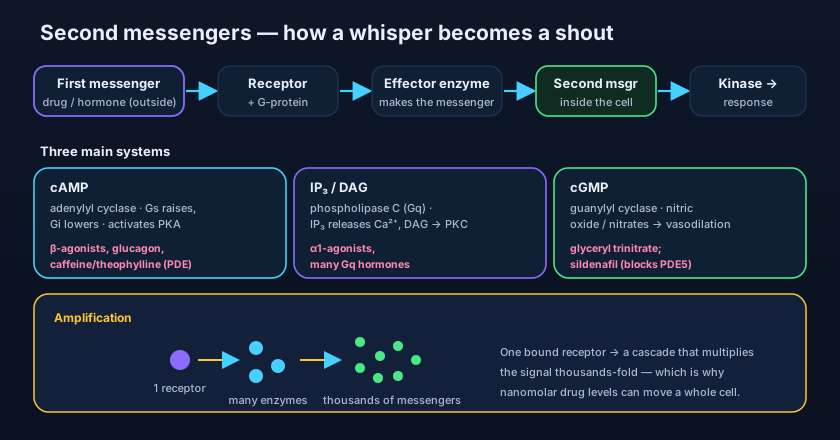
- Most drugs stay outside as a first messenger; the receptor → G-protein → effector enzyme relay makes a second messenger inside.
- cAMP (Gs up, Gi down, via PKA), IP₃/DAG (Gq → Ca²⁺ + PKC), and cGMP (NO/nitrates) are the classic systems; Ca²⁺ is near-universal.
- PDE inhibitors (caffeine, theophylline, milrinone, sildenafil) prolong the signal by blocking breakdown, not by making more.
- Each relay step multiplies the signal thousands-fold — amplification — so nanomolar drug levels move whole cells, foreshadowing spare receptors.
- Rang HP, Dale MM, et al. Rang & Dale's Pharmacology — How drugs act: cellular mechanisms & second-messenger systems.
- Katzung BG. Basic & Clinical Pharmacology — Drug receptors & pharmacodynamics: signalling mechanisms & amplification.
- Brunton LL, et al. Goodman & Gilman's The Pharmacological Basis of Therapeutics — Signal transduction: G-proteins, cyclic nucleotides & phospholipase C.
- Whalen K. Lippincott Illustrated Reviews: Pharmacology — Signal transduction & second messengers.
- Boron WF, Boulpaep EL. Medical Physiology — Signal transduction: cAMP, cGMP, IP₃/DAG & calcium.

