
Asthma vs COPD: One Reverses, One Doesn't
Asthma and COPD both cause breathlessness, wheeze and cough from narrowed airways — yet they are fundamentally different diseases, and one single distinction drives almost all of their treatment. Get that distinction clear and you'll instantly understand why steroids are central to one and bronchodilators to the other.
From the outside, asthma and COPD can look alike: both leave people wheezy, breathless and coughing because air can't move freely through narrowed airways. But underneath they're two different stories. Asthma is typically a disease of allergic, twitchy airways — often starting young, often in non-smokers — where the airways narrow in attacks and then open up again. COPD (chronic obstructive pulmonary disease) is typically a disease of long-term damage, overwhelmingly caused by smoking, where the airways and lung tissue are progressively and permanently harmed. The one word that captures the whole difference — and predicts the treatment — is reversibility.
Reversible vs fixed — the master distinction
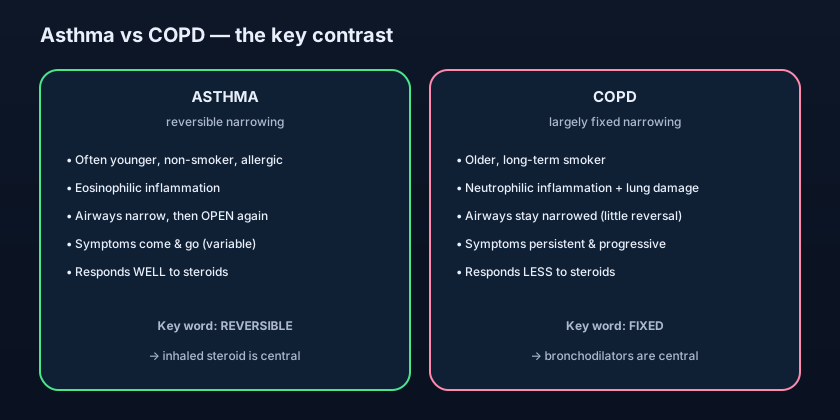
Asthma opens back up; COPD largely stays narrowed. In asthma, the airway narrowing is largely reversible: the muscle tightens and the lining swells during an attack, but with treatment (or between attacks) the airway opens back up toward normal. The underlying process is allergic-type inflammation, driven by immune cells called eosinophils — and this matters enormously, because that kind of inflammation responds beautifully to steroids. In COPD, by contrast, the narrowing is largely fixed: years of smoke have inflamed and destroyed lung tissue, leaving airways that are permanently narrowed and don't fully open even with treatment. Its inflammation is a different type (more neutrophil-driven) that responds much less well to steroids. So the same symptom — a narrowed airway — has opposite implications: in asthma you can reverse it and prevent it; in COPD you can ease it and slow its progression, but you can't undo the damage already done. This is why a breathing test showing how much the airways open after a bronchodilator (reversibility testing) helps tell the two apart.
Why the distinction sets the treatment
This single difference explains the whole shape of treatment in the articles that follow. Because asthma is fundamentally a reversible, eosinophilic inflammatory disease, its cornerstone treatment is the inhaled steroid (the controller) that treats that inflammation — with bronchodilators as relievers for symptoms. Modern asthma care actually insists that everyone with asthma is on some inhaled steroid, precisely because treating the inflammation is what prevents attacks and deaths; a reliever alone is not enough. COPD flips the emphasis: because its inflammation responds poorly to steroids and the damage is fixed, the backbone of treatment is long-acting bronchodilators, which keep the airways as open as they can be day to day. Inhaled steroids are added in COPD only for certain patients (particularly those with frequent flare-ups or features overlapping with asthma), not for everyone. And running underneath COPD is the single most important intervention of all — stopping smoking, the only thing that actually slows the disease. So: asthma → treat the reversible inflammation with steroids; COPD → keep the fixed airways open with bronchodilators and stop the smoke. Every drug in the next articles slots into one side of this divide.
- Asthma = reversible airway narrowing; COPD = largely fixed narrowing + lung damage.
- Asthma: allergic/eosinophilic, often younger non-smokers, variable — responds WELL to steroids.
- COPD: smoking-related, neutrophilic, persistent/progressive — responds LESS to steroids.
- Asthma cornerstone = inhaled steroid (everyone); COPD backbone = long-acting bronchodilators.
- Stopping smoking is the single most important intervention in COPD.
One word, reversibility, unlocks the entire respiratory section. Asthma's narrowing reverses because it's driven by steroid-responsive allergic inflammation — so you treat the inflammation, and the modern rule is that no one with asthma should be on a reliever alone. COPD's narrowing is largely fixed because it's structural damage from smoke that steroids can't undo — so you focus on keeping the airways open with bronchodilators and, above all, on stopping the smoke that's still causing harm. When you meet any respiratory drug, first ask which disease it's really for, then ask whether it's opening the airway or treating the inflammation. Those two questions, anchored on reversibility, organise everything that follows.
- Treating asthma with a reliever alone — everyone with asthma needs an inhaled steroid.
- Expecting steroids to work as well in COPD as in asthma — COPD responds much less.
- Overlooking smoking cessation in COPD — it's the only thing that slows the disease.
- Assuming asthma and COPD are the same because the symptoms overlap.
What is the key distinction between asthma and COPD that drives treatment?
- Asthma = reversible, allergic/eosinophilic narrowing; COPD = largely fixed, smoking-related damage.
- Asthma responds well to steroids (the cornerstone); COPD responds less.
- Asthma → inhaled steroid for everyone; COPD → long-acting bronchodilators as the backbone.
- Stopping smoking is the single most important step in COPD.
- Katzung BG. Basic & Clinical Pharmacology — Drugs Used in Asthma & COPD.
- Brunton LL, et al. Goodman & Gilman's The Pharmacological Basis of Therapeutics — Pulmonary pharmacology.
- GINA & GOLD — Global strategies for asthma and COPD.
- Rang HP, Dale MM, et al. Rang & Dale's Pharmacology — Asthma & COPD.

