
Inhaled Corticosteroids: The Drug That Actually Treats Asthma
Bronchodilators open the airway, but they don't treat the disease. The inhaled corticosteroid does — it calms the underlying inflammation that makes asthma dangerous, which is why it's the true cornerstone of asthma treatment. And by delivering a powerful steroid straight to the lungs, it captures all the benefit of steroids with almost none of their whole-body cost.
It's tempting to think the reliever inhaler IS the asthma treatment — after all, it's what makes you breathe easily when you're wheezy. But it only opens the airway; it does nothing about the inflammation that is the real disease underneath. That inflammation is what makes airways twitchy, what causes attacks, and what can kill. The drug that treats it is the inhaled corticosteroid (ICS) — a steroid, exactly like the ones from the endocrine chapter, but delivered straight to the airways. This is why the ICS, not the reliever, is the cornerstone of asthma care, and why modern guidelines say no one with asthma should be treated with a reliever alone.
Why inhaled steroids are so safe
The endocrine chapter's steroid dangers mostly vanish when you inhale it. In the endocrine chapter you learned that steroids are powerful anti-inflammatories with a long list of serious side effects — but that list came from taking them as tablets, which flood the whole body. Inhaling the steroid changes everything. The drug (budesonide, fluticasone, beclometasone and others) lands directly on the inflamed airways where it's needed, so a tiny dose does the job, and very little reaches the bloodstream. This means the frightening systemic effects of steroid tablets — diabetes, osteoporosis, Cushing's appearance, adrenal suppression — are largely avoided at normal inhaled doses. What's left are mainly local side effects, in the mouth and throat where some drug inevitably lands: oral thrush (a fungal infection) and a hoarse voice. Both are easily prevented by rinsing the mouth after each dose (and by using a spacer, which leaves less drug in the mouth). This is the ICS's great advantage: nearly all the anti-inflammatory benefit of a steroid, with only mild, local, preventable side effects — the topical principle from the very first article, applied to the most important controller in respiratory medicine.
Combination inhalers and the treatment ladder
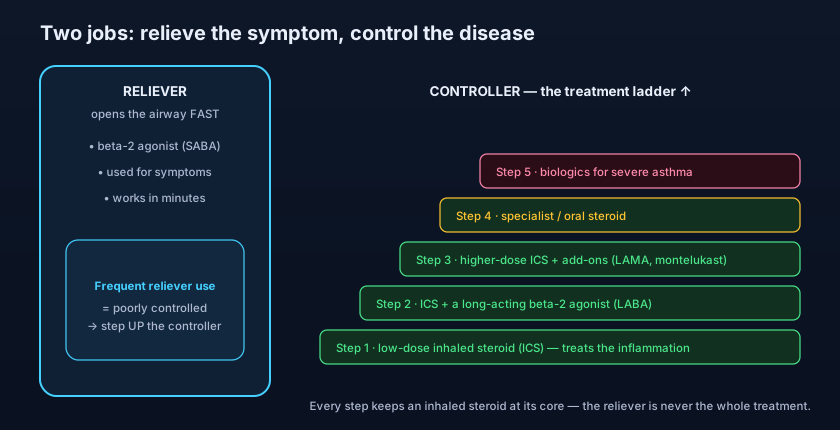
Asthma treatment is a ladder that you step up or down to match how well-controlled the person is. The foundation is a regular inhaled steroid. If that isn't enough, the next step is to add a long-acting beta-2 agonist (LABA) — and here the two are almost always given together in a single combination inhaler (a steroid + LABA in one device, like budesonide/formoterol or fluticasone/salmeterol). This is deliberate and important: recall from the beta-2 article that a LABA must never be used alone in asthma, and putting both drugs in one inhaler guarantees the patient can never take the LABA without its protective steroid. A modern, elegant approach called MART even uses a single steroid/formoterol inhaler as BOTH the daily controller AND the reliever, so every rescue puff also delivers a dose of steroid. Higher up the ladder come higher steroid doses, add-on drugs (like a LAMA or montelukast, in the next article), and finally biologics for severe disease. The key idea to carry: a steroid sits at the heart of every rung — you never climb the ladder by piling on bronchodilators while leaving the inflammation untreated.
- Inhaled corticosteroids (ICS) treat the airway inflammation — the true cornerstone of asthma care.
- Inhaled route avoids the systemic side effects of steroid tablets — only mild local effects remain.
- Local side effects: oral thrush and hoarse voice — prevent by rinsing the mouth (and using a spacer).
- Step up asthma treatment: ICS → ICS + LABA (combination inhaler) → higher dose/add-ons → biologics.
- A steroid sits at the core of every step; combination inhalers ensure a LABA is never taken alone.
The inhaled corticosteroid is the purest demonstration of the topical principle in the whole book. Take the very same steroid molecule you feared in the endocrine chapter — the one that causes diabetes, osteoporosis and adrenal shutdown as a tablet — and deliver it by inhaler instead, and its dangers almost vanish, because it now acts in the airways and barely enters the bloodstream. What's left is just a little thrush in the mouth, wiped out by a rinse. It's the same drug; only the route changed. This is why the ICS can be taken safely every day for years to control a lifelong disease, and it's the reason the inhaler transformed asthma from a frequently fatal condition into a controllable one.
- Treating asthma with a reliever only — the inflammation stays untreated; add an ICS.
- Forgetting to advise rinsing the mouth after an ICS — thrush and hoarseness.
- Giving a LABA in a separate inhaler in asthma — use a combination inhaler so it's never taken alone.
- Fearing inhaled steroids as if they were steroid tablets — the systemic risk is far lower.
What is the true cornerstone of long-term asthma treatment?
- Inhaled corticosteroids treat asthma's underlying inflammation — the real cornerstone, not the reliever.
- Inhaling avoids the systemic dangers of steroid tablets; only mild local effects (thrush, hoarseness) remain.
- Rinse the mouth after each dose; step up ICS → ICS+LABA (combination) → add-ons → biologics.
- A steroid sits at the core of every step; combination inhalers keep a LABA from being used alone.
- Katzung BG. Basic & Clinical Pharmacology — Drugs Used in Asthma (corticosteroids).
- Brunton LL, et al. Goodman & Gilman's The Pharmacological Basis of Therapeutics — Inhaled glucocorticoids.
- GINA — Global Initiative for Asthma (ICS & combination therapy, MART).
- Whalen K. Lippincott Illustrated Reviews: Pharmacology — Inhaled corticosteroids.