
How the Airways Work — and Why We Inhale the Drug
Almost every drug in this section is breathed in rather than swallowed, and that isn't an accident — it's the single most important idea in respiratory pharmacology. Understand what narrows an airway and why we deliver the drug straight to the lungs, and every inhaler, bronchodilator and steroid that follows will make immediate sense.
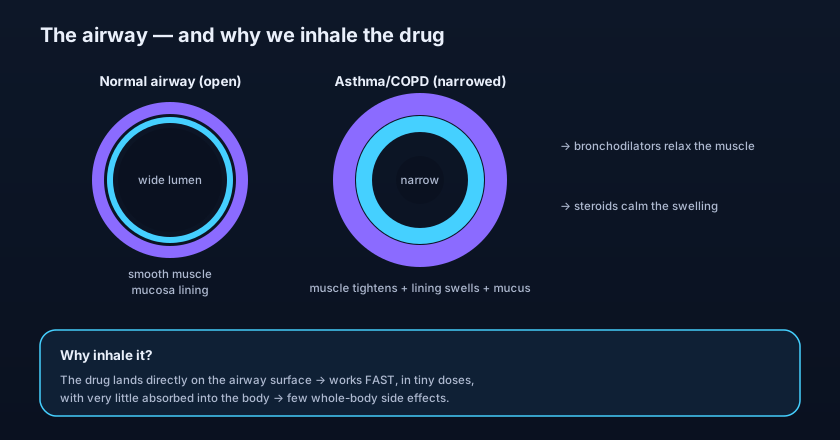
Picture the airways as a branching tree of soft tubes carrying air deep into the lungs. Each tube's wall has two things that matter for our drugs: a ring of smooth muscle wrapped around it, and a delicate lining (the mucosa) on the inside. When all is well, the muscle is relaxed and the lining is thin, so the tube is wide open and air flows freely. Disease strikes this tube in a few predictable ways — the muscle tightens, the lining swells with inflammation, and mucus clogs the space — all narrowing the airway and making breathing a struggle. Almost everything in respiratory medicine is about reversing those changes: relax the muscle, calm the swelling, clear the mucus. And the clever part is HOW we deliver those drugs.
The two targets: muscle and lining
Two problems, two families of drug. The narrowing of an airway comes from two separate problems, and respiratory drugs divide neatly along the same line. First, the ring of smooth muscle can contract and squeeze the tube shut — bronchoconstriction. The drugs that fix this are the bronchodilators (the relievers), which relax that muscle and rapidly widen the airway; you'll meet them as the beta-2 agonists and antimuscarinics, and their names come straight from the autonomic nervous system chapter, because the same receptors that control the heart and glands also control airway muscle. Second, the lining can become inflamed and swollen, and mucus builds up — a slower, underlying problem. The drugs that fix this are the anti-inflammatories (the controllers), chiefly the inhaled corticosteroids, which calm the inflammation over days to weeks. This gives us the single most important framework in respiratory medicine: relievers open the airway quickly by relaxing muscle; controllers treat the underlying inflammation over time. Keep those two jobs separate and the whole section falls into place.
Why we inhale — the topical advantage
Here is the defining idea of respiratory pharmacology: we deliver most of these drugs by inhalation, straight to the airways, and this is a deliberate and powerful choice. Think of it as topical treatment for the lungs. Because the inhaled drug lands directly on the airway surface where the problem is, it works fast and only a tiny dose is needed — and crucially, very little of it is absorbed into the rest of the body, so whole-body side effects are minimal. This is exactly why an inhaled steroid can be used long-term for asthma without the serious side effects of steroid tablets from the endocrine chapter: the drug acts in the airways and barely reaches the bloodstream. It's the same principle you met with skin creams and eye drops — put the drug where the disease is, and you gain a big local effect for a small systemic price. This single advantage is why the inhaler, not the tablet, is the icon of respiratory medicine, and why getting the drug into the lungs properly (the subject of the next article) matters so much.
- An airway is a tube of smooth muscle lined by mucosa; disease narrows it (tight muscle, swollen lining, mucus).
- Two drug families: bronchodilators (relievers) relax muscle fast; controllers (steroids) calm inflammation over time.
- Bronchodilator receptors come straight from the autonomic nervous system (beta-2, muscarinic).
- We INHALE the drug: topical delivery to the airway → fast effect, tiny dose, minimal systemic absorption.
- That's why inhaled steroids avoid the systemic side effects of steroid tablets.
The reliever-versus-controller split is the master key to this whole section, and it maps onto the two things wrong with a diseased airway. A tight muscle is a fast, acute problem, so it needs a fast fix — a bronchodilator that relaxes the muscle within minutes (the 'reliever' you grab when breathless). Inflammation is a slow, smouldering problem, so it needs slow, steady treatment — an inhaled steroid taken every day whether you feel breathless or not (the 'controller' or 'preventer'). Patients get into trouble when they confuse the two: over-relying on the reliever while under-using the controller means the underlying inflammation is never treated. Every asthma and COPD drug you meet is one or the other — always ask 'is this opening the airway, or calming the inflammation?'
- Confusing relievers (open the airway fast) with controllers (treat inflammation over time).
- Assuming inhaled drugs act like tablets — inhalation is topical, with minimal systemic effect.
- Forgetting airway drugs use the autonomic receptors (beta-2, muscarinic) from the ANS chapter.
- Overusing a reliever while neglecting the controller — the inflammation goes untreated.
Why does an inhaled steroid avoid the side effects of steroid tablets?
- Airways narrow from tight muscle, swollen lining and mucus; drugs reverse these.
- Relievers (bronchodilators) open the airway fast; controllers (steroids) calm inflammation over time.
- Airway drugs reuse autonomic receptors (beta-2, muscarinic) from the ANS chapter.
- We inhale for a fast local effect with minimal systemic absorption and side effects.
- Katzung BG. Basic & Clinical Pharmacology — Drugs Used in Asthma & COPD.
- Brunton LL, et al. Goodman & Gilman's The Pharmacological Basis of Therapeutics — Pulmonary pharmacology.
- Rang HP, Dale MM, et al. Rang & Dale's Pharmacology — The respiratory system.
- Guyton & Hall. Textbook of Medical Physiology — Respiration & airway function.

