
Paracetamol Poisoning: NAPQI and the N-Acetylcysteine Rescue
Paracetamol is the safest drug in the medicine cabinet — until it isn't. At the right dose it is so gentle it is given to newborns and pregnant women; in overdose it is the commonest cause of acute liver failure in the Western world and the drug most often reached for in deliberate self-harm. The cruelty is in the timing: the patient who has taken a fatal amount feels completely well for a day or two, walks and talks normally, and only declares itself when the liver is already dying. The whole discipline of poisoning turns on this single deception — and on an antidote so good that, given in time, it makes the poisoning almost survivable to a certainty.
A 19-year-old is brought to the emergency department after telling a friend she swallowed "a whole box" of paracetamol the night before — around ten hours ago. She looks completely well. Her observations are normal, she is chatting, mildly embarrassed, asking to go home. There is no smell, no drowsiness, no pain — none of the drama a poisoning is supposed to have. Every instinct says she is fine. The blood test tells another story: her paracetamol level, plotted against the hours since ingestion, sits just above the treatment line, and her ALT is already beginning to creep up. She is not fine at all — she is in the quiet, deceptive gap before the liver fails, and the antidote must start now, before she feels a single symptom. Treated tonight she will almost certainly walk out unharmed. Missed until she feels ill in three days, she may need a new liver to live.
The therapeutic dose: mostly harmless
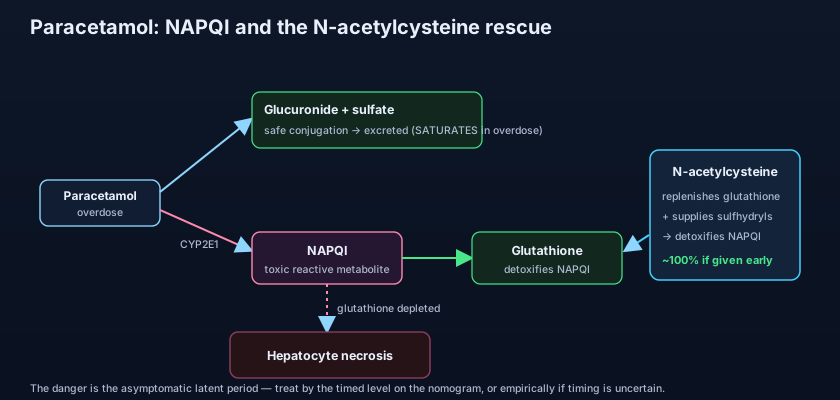
At normal doses, the liver disposes of paracetamol quietly and completely. Swallow a normal dose and the liver deals with it by phase II conjugation — the same machinery covered in the Principles of Pharmacology chapter. The great majority of the drug is coupled to glucuronide or sulfate, turned into a harmless water-soluble compound, and passed out in the urine. Only a small fraction takes a different, more dangerous road: it is oxidised by the cytochrome enzyme CYP2E1 into a highly reactive metabolite called NAPQI (N-acetyl-p-benzoquinone imine). NAPQI is a toxin. But at therapeutic doses it is produced in such tiny amounts that the liver's stock of glutathione — a small protective thiol molecule — instantly grabs it, neutralises it, and excretes it safely. The poison is made every time you take the drug; it simply never accumulates.
Overdose: the pathways saturate and NAPQI wins
In overdose the arithmetic breaks. The glucuronidation and sulfation pathways are high-capacity but finite; flood them with paracetamol and they saturate — this is the conjugation saturation the Principles of Pharmacology chapter describes for phase II metabolism. With the safe roads jammed, a far larger share of the drug is diverted down the CYP2E1 route, and NAPQI is produced in bulk. At first glutathione keeps mopping it up, but the stores are limited: once glutathione falls to roughly 30% of normal, the mop runs dry. Now free, unquenched NAPQI does what a reactive electrophile does — it binds covalently to the sulfhydryl groups of hepatocyte proteins, wrecking mitochondrial function and triggering cell death. The damage is concentrated in the centrilobular (zone 3) region of the liver, where CYP2E1 is richest, producing the characteristic centrilobular hepatic necrosis. In severe cases the kidneys, which also carry CYP2E1, are injured too.
Think of glutathione as a fire bucket standing next to a small, controlled flame. At a therapeutic dose the flame (NAPQI) is a match-head — one splash from the bucket and it is out, every time. An overdose is not a bigger match; it is a bonfire. The same bucket empties long before the fire is controlled, and once the water is gone the flames spread to everything nearby — the hepatocytes. N-acetylcysteine is the fire brigade arriving to refill the bucket, endlessly, until the last of the fuel has burned itself out. Refill it while the fire is still a match-head and nothing burns; arrive after the bonfire is roaring and you are salvaging a scorched building.
The four deceptive phases
The natural history of the poisoning is a trap built out of feeling well. Untreated paracetamol poisoning moves through four phases, and the first is the one that kills. Phase 1 (0–24 hours): the patient is well or has only mild nausea and vomiting — this is the treacherous latent period, when the level may be lethal yet the patient looks and feels normal. Phase 2 (24–72 hours): the patient may seem to improve, but the liver is now injured — right upper quadrant pain and tenderness appear and the transaminases (ALT, AST) climb, often to enormous heights. Phase 3 (72–96 hours): the peak of hepatotoxicity — fulminant hepatic failure with jaundice, coagulopathy, encephalopathy, hypoglycaemia and lactic acidosis; this is when patients die of liver failure or need a transplant. Phase 4 (4 days–2 weeks): survivors recover, and the liver — if it survives — regenerates completely, usually without chronic scarring. The lesson echoes the "lethal latent period" theme of the Approach to the Poisoned Patient chapter: in toxicology, a well-looking patient is not a reassuring patient.
- At therapeutic dose, most paracetamol is safely conjugated (glucuronide/sulfate); a small fraction goes via CYP2E1 to toxic NAPQI.
- Glutathione normally neutralises NAPQI instantly, so it never accumulates.
- In overdose the conjugation pathways saturate, more NAPQI forms, and glutathione is depleted.
- Free NAPQI binds hepatocyte proteins → centrilobular (zone 3) hepatic necrosis, sometimes with renal injury.
- Four phases: (1) well/latent, (2) RUQ pain + rising transaminases, (3) fulminant hepatic failure at 3–4 days, (4) recovery.
- The danger is the asymptomatic latent period — a normal-looking patient can carry a lethal level.
Risk assessment: the timed level and the nomogram
Because the patient's appearance is worthless as a guide, risk is decided by numbers. The cornerstone is a paracetamol concentration measured at a known time after a single acute ingestion, taken no earlier than 4 hours (before that, absorption is incomplete and the level is uninterpretable). The value is plotted on the Rumack–Matthew nomogram — a graph of paracetamol concentration against hours since ingestion, with a treatment line running down it. A level on or above the line means significant risk of hepatotoxicity: treat. The nomogram is a beautiful tool but it has strict limits: it is valid only for a single, well-timed acute overdose taken within the previous 24 hours. It is useless for staggered overdoses (repeated supratherapeutic doses spread over hours or days) and for presentations where the timing is unknown or beyond 24 hours — in all of these, you cannot rely on the graph and should treat based on dose history, symptoms and blood results instead. A special trap is modified-release paracetamol, whose prolonged absorption can push the level back above the line after an initially reassuring reading, so a single early level can falsely reassure.
The antidote: N-acetylcysteine
N-acetylcysteine is the model antidote — it works precisely by refilling the tank the poison emptied. N-acetylcysteine (NAC) attacks the problem at its root. It is a precursor for glutathione synthesis, so it replenishes the depleted glutathione stores and lets the liver resume detoxifying NAPQI; it also provides sulfhydryl groups that can bind and neutralise NAPQI directly; and at high levels it enhances the safe sulfate conjugation pathway. The single most important fact about NAC is that it is time-critical: given within roughly 8 hours of ingestion it is almost completely hepatoprotective — patients treated this early very rarely develop serious liver injury. Its efficacy falls the longer it is delayed, because by then NAPQI has already bound its targets. Two management principles follow. First, if the timing is uncertain, or the level will not return before that 8-hour window closes, give NAC empirically and stop later if the risk assessment turns out reassuring — you never withhold a near-perfect antidote to wait for a number. Second, NAC still has value late: even in established hepatic failure it improves outcomes, so "too late for the nomogram" is not "too late for NAC." This mechanism-first thinking belongs to the Enhanced-elimination & Antidotes chapter, where NAC stands as the archetype of an antidote that restores a depleted physiological defence rather than blocking a receptor.
NAC has one notorious quirk students must expect: anaphylactoid reactions. During the infusion — especially early, when the concentration is highest — patients commonly develop flushing, urticaria, itch, and sometimes wheeze. Crucially, these are non-allergic (anaphylactoid, histamine-driven) reactions, not true IgE allergy, and they are dose-rate dependent. The correct response is almost never to abandon the antidote: the infusion is paused or slowed and an antihistamine given, then NAC is restarted. Stopping a life-saving antidote because of a manageable flush is a classic error. Alongside NAC, general poisoning care applies: activated charcoal can be considered if the patient presents within an hour of a significant ingestion, and supportive care manages the hepatic failure.
When the liver can't be saved: transplant referral
A minority progress to fulminant hepatic failure despite treatment, and here the decision is whether the liver can recover on its own or whether the patient needs an emergency transplant. The King's College Criteria are the classic tool for flagging patients whose prognosis without transplant is grim: an arterial pH below 7.3 after adequate fluid resuscitation, or the combination of a high prothrombin time / INR, a raised creatinine, and grade III–IV hepatic encephalopathy. Meeting these criteria triggers urgent referral to a liver transplant unit. Rising lactate and a persistently climbing INR are the ominous trends. The point for a pharmacology learner is not to memorise the thresholds but to understand what they encode: they identify the patient in whom the poison has outrun both the native liver and the antidote.
The exam-and-life gotcha of paracetamol is the inverted relationship between how the patient looks and how sick they are. Every other poisoning teaches you to treat the symptomatic patient; this one punishes that instinct. The sickest paracetamol patient in the department is often the one who feels perfectly fine — because feeling fine means you are still inside the latent window, which is exactly the window in which the antidote is near-perfect. By the time the patient looks unwell, the NAPQI has already bound and the best hours have passed. In paracetamol poisoning, reassurance is the enemy: you treat the number and the clock, not the face.
Paracetamol's therapeutic pharmacology — its analgesic and antipyretic action, thought to involve central COX inhibition and other pathways, with negligible peripheral anti-inflammatory effect — is covered in the Gastrointestinal / Inflammation section alongside the NSAIDs. That same section explains why it is the preferred first-line analgesic in so many patients: it spares the stomach and platelets that NSAIDs injure. The toxicological twist is that its safety at normal doses and its lethality in overdose spring from the very same hepatic metabolism — the small CYP2E1 fraction that is harmless when glutathione is plentiful and catastrophic when it is not.
- Risk after a single acute overdose is decided by a timed level (≥4 hours) plotted on the Rumack–Matthew nomogram.
- The nomogram is invalid for staggered, late (>24 h), or unknown-timing overdoses — treat on history instead.
- Modified-release paracetamol can push the level back above the line — one early level can falsely reassure.
- N-acetylcysteine replenishes glutathione and provides sulfhydryl groups to detoxify NAPQI.
- NAC is near-100% hepatoprotective within ~8 hours; give it empirically when timing is uncertain, and it still helps late.
- Anaphylactoid reactions to NAC are common but non-allergic — slow/pause the infusion, don't abandon it.
- Being reassured by a well-looking patient. In the latent phase a lethal ingestion looks entirely normal — treat the timed level, not the appearance.
- Stopping N-acetylcysteine because of flushing or a rash. The anaphylactoid reaction is non-allergic and rate-dependent — pause/slow the infusion and give an antihistamine, then continue.
- Applying the nomogram to a staggered or unknown-time overdose, or trusting one early level after a modified-release product — none of these fit the graph, so treat on clinical grounds.
A 20-year-old presents 6 hours after ingesting around 25 g of immediate-release paracetamol in a single overdose. She feels well, with only mild nausea; observations and examination are normal. What is the most appropriate management?
- At therapeutic dose paracetamol is mostly safely conjugated; a small CYP2E1 fraction becomes toxic NAPQI, which glutathione neutralises.
- In overdose the conjugation pathways saturate, glutathione is depleted, and free NAPQI binds hepatocytes → centrilobular hepatic necrosis.
- The danger is the asymptomatic latent phase; risk is judged by a timed level on the Rumack–Matthew nomogram (invalid for staggered/late/modified-release cases).
- N-acetylcysteine refills glutathione and detoxifies NAPQI — near-perfect within ~8 hours, give empirically if timing is uncertain, and continue through anaphylactoid reactions; refer by King's College criteria if fulminant failure develops.
- Goldfrank's Toxicologic Emergencies — Acetaminophen (paracetamol).
- Rang & Dale's Pharmacology — Analgesics: paracetamol and NSAIDs.
- Katzung, Basic & Clinical Pharmacology — Management of the poisoned patient; acetaminophen.
- British National Formulary (BNF) — Emergency treatment of poisoning: paracetamol.
- UpToDate / TOXBASE — Acetaminophen (paracetamol) poisoning: diagnosis and management.
- Rumack BH, Matthew H. Acetaminophen poisoning and toxicity (the Rumack–Matthew nomogram).