
Heavy Metals and Chelation: Lead, Mercury and Arsenic
Heavy metals poison in a peculiar way: they don't have a single receptor to block or an enzyme to switch off. Instead they behave like molecular saboteurs, latching onto sulfhydryl groups scattered across hundreds of proteins and enzymes, jamming machinery everywhere at once. That is why the poisoning is so protean — a bit of anaemia here, a numb foot there, a line on the gum, a garlic smell on the breath. And it is why the antidote is not a blocker but a kidnapper: a chelator that out-competes the body's proteins for the metal, wraps it into a soluble parcel, and posts it out in the urine. Master the chelators and you master the whole subject.
A 3-year-old boy is brought to the emergency department irritable, vomiting, and unsteady on his feet, drifting towards drowsiness. His family recently renovated an old house, and he has a habit of chewing painted windowsills. His blood film shows small, pale red cells peppered with tiny blue dots — basophilic stippling — and his blood lead level comes back dangerously high. This is not a tumour or an infection; it is a metal quietly dismantling his haem synthesis and swelling his brain. He is developing lead encephalopathy. The treatment is not a drug that soothes the brain but one that physically grabs the lead atoms and drags them out of him — chelation. The team readies dimercaprol and calcium disodium EDTA, and the clock starts.
Why metals are poisons — the sulfhydryl problem
A heavy metal doesn't hit one target; it gums up thousands. The toxic heavy metals — lead, mercury, arsenic — share a chemical vice: a high affinity for sulfur. Countless proteins carry free sulfhydryl (thiol, –SH) groups at the business end of their active sites, and metals bind these groups avidly, distorting the protein and shutting the enzyme down. Because thiol groups are everywhere, so is the damage: enzymes of haem synthesis, mitochondrial energy metabolism, antioxidant defence, and nerve function are all vulnerable at once. Arsenic adds its own trick, binding the lipoic-acid cofactor of pyruvate dehydrogenase and choking the entry to the Krebs cycle. The clinical lesson is that metal toxicity is multi-system by nature — and that the antidote must beat the body's own thiols at their own game.
The antidote principle: what a chelator actually does
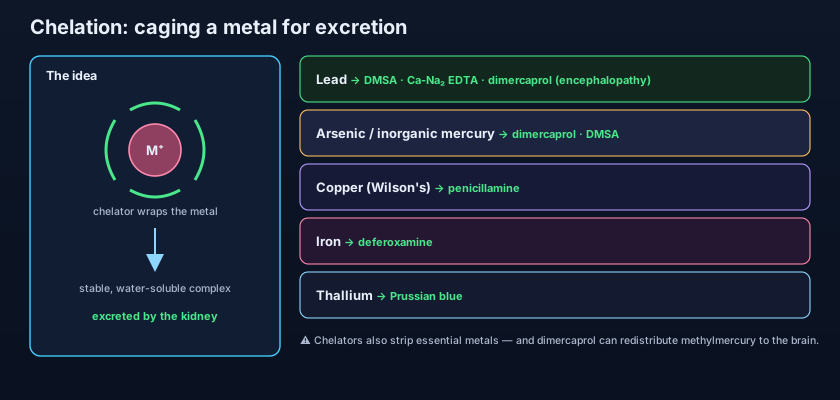
A chelator is a molecule with two or more donor groups — typically sulfhydryls, but also carboxyl or amine groups — arranged so they can clamp a metal ion from several sides at once, like a claw. (The word comes from the Greek chele, a crab's pincer.) By offering the metal a richer, tighter set of bonds than the body's own proteins can, the chelator strips the metal off its targets and locks it into a stable ring-shaped complex. Crucially, that complex is water-soluble and non-toxic, so the kidney (or the bile) can filter it out and excrete it. The enzyme that was poisoned is freed; the metal leaves in the urine. Everything else about heavy-metal treatment is a question of choosing the right claw for the right metal, and getting it in before too much irreversible damage is done.
Picture the poisoned enzyme as a lock, and the metal ion as a broken key snapped off inside it, jamming the whole mechanism. You cannot pull the fragment out with your fingers — it is wedged too tight. A chelator is a purpose-built magnetic grabber, shaped with several arms that grip the metal fragment far more firmly than the lock ever could. It plucks the fragment free, encases it in a smooth capsule that can't snag on anything else, and carries it out of the building through the plumbing. The lock works again; the broken key is gone for good.
Lead: the enzyme thief
Old paint, car batteries, contaminated cookware, and some traditional remedies remain the classic sources. Lead's signature is its assault on haem synthesis. It inhibits several enzymes of the pathway — most notably ALA dehydratase and ferrochelatase, the last step that inserts iron into protoporphyrin. Haem production falls, so you get a microcytic anaemia, while the retained ribosomal RNA in red cells clumps into the basophilic stippling seen on the film. This connects directly to the Haematology chapter, where lead sits alongside the sideroblastic and microcytic anaemias. Neurologically, lead is devastating: in children it causes encephalopathy and lasting cognitive impairment (there is no safe blood level in a child), while in adults it classically produces a peripheral motor neuropathy — the wrist drop and foot drop of the old "painter's palsy." Add a blue-black lead line along the gums, colicky abdominal pain ("lead colic"), and, over time, kidney injury and gout, and you have the full picture.
Treatment is tiered by severity. For a child or adult with moderate poisoning and no encephalopathy, oral DMSA (succimer) is the workhorse — a water-soluble dimercaprol relative that is given by mouth and is comparatively safe. For severe poisoning with encephalopathy, the approach escalates to parenteral therapy: dimercaprol (BAL) given first, followed by calcium disodium EDTA. The order matters. EDTA given alone can mobilise lead and transiently redistribute it to the brain, so dimercaprol is started first to mop up and protect the CNS; only then is EDTA added to pull the larger burden out through the kidneys. Removing the source — and, in children, screening the home and siblings — is as important as any drug.
- Metals poison by binding sulfhydryl groups on hundreds of enzymes — toxicity is multi-system.
- A chelator clamps the metal into a stable, water-soluble complex excreted in urine or bile.
- Lead inhibits haem synthesis → microcytic anaemia with basophilic stippling.
- Lead neurotoxicity: encephalopathy in children; wrist/foot drop in adults; gum line and colic.
- Moderate lead → oral DMSA; encephalopathy → dimercaprol first, then calcium disodium EDTA.
- There is no safe blood lead level in a child — always remove the source.
Mercury: it matters which mercury
Mercury is really three toxins wearing one name, and the form dictates both the picture and the treatment. Elemental mercury (the liquid metal and its vapour, from broken thermometers or gold mining) is barely absorbed if swallowed but dangerous when inhaled, reaching the brain to cause tremor, erethism (irritability and personality change — the "mad hatter"), and gingivitis. Inorganic mercury salts, if ingested, are corrosive to the gut and severely nephrotoxic, causing acute tubular necrosis. Organic mercury — above all methylmercury, concentrated up the food chain into large predatory fish — is the lipophilic form that crosses into the brain and the placenta, producing the sensory neuropathy, ataxia, visual-field constriction, and devastating fetal neurotoxicity seen in the Minamata Bay disaster. Its slow, largely neurological presentation links to the Central Nervous System section.
For mercury, one chelation rule can do real harm if forgotten. Elemental and inorganic mercury poisoning is treated with chelation — DMSA orally where possible, or dimercaprol for severe acute inorganic poisoning to protect the kidneys. But for methylmercury the crucial caution is: do not use dimercaprol. The dimercaprol–mercury complex is lipophilic and can redistribute mercury into the brain, worsening the very neurotoxicity you are trying to treat. DMSA (water-soluble, so its complex leaves in the urine rather than entering the CNS) is the safer choice for organic mercury. This single distinction — the right claw can move a metal to exactly the wrong place — is one of the most testable ideas in metal toxicology.
Arsenic: the poisoner's poison
Arsenic has a long, dark history as a homicidal poison — tasteless, odourless in food, and once hard to detect — but today most cases are environmental (contaminated groundwater, as in parts of South Asia), occupational, or from pesticides and old wood preservatives. Acute poisoning is dramatic: severe gastroenteritis with profuse "rice-water" stools and vomiting, a reported garlicky odour on the breath, and cardiovascular collapse. On the ECG, arsenic prolongs the QT interval and can precipitate the polymorphic ventricular tachycardia torsades de pointes. Survivors and chronically exposed patients develop a painful sensorimotor peripheral neuropathy, and skin changes — hyperpigmentation, hyperkeratosis of the palms and soles, and later skin cancers. A classic late sign is Mees' lines: transverse white bands across the nails, a quiet signature the metal leaves behind weeks after the exposure.
The antidote for symptomatic acute arsenic poisoning is chelation with dimercaprol (BAL) initially — it is the traditional choice for arsenic and works well because arsenic, like the metals, binds thiols — transitioning to oral DMSA once the patient is stable and can absorb it. Aggressive fluid and electrolyte resuscitation is essential alongside, because the gastrointestinal losses can be as life-threatening as the metal itself. As always, chelation is most useful early, before the neuropathy and skin disease become fixed.
Copper, Wilson's disease, and the specialist chelators
Not every metal overload comes from outside. In Wilson's disease, an inherited defect in copper transport lets copper accumulate in the liver, brain, and the eye's Kayser–Fleischer rings, producing hepatic and neuropsychiatric disease. Here the chelator of choice is penicillamine, which mobilises copper for urinary excretion (trientine is an alternative, and zinc blocks copper absorption). Penicillamine also has a secondary role as an oral adjunct in lead poisoning. This inherited-overload story links to the Endocrine and Hepatic chapters, where Wilson's disease is worked up in full. Two further specialist agents complete the toolkit: Prussian blue, which is not absorbed but sits in the gut binding thallium and radioactive caesium so they are excreted in the stool rather than reabsorbed; and — on the same chelation logic but for a different metal — deferoxamine, the chelator for iron overdose and iron overload, covered in the Iron and haematinics chapter.
Dimercaprol (BAL) — intramuscular, in peanut oil; for lead encephalopathy (with EDTA), acute arsenic, and inorganic/elemental mercury; avoid in methylmercury (brain redistribution) and in G6PD deficiency. DMSA (succimer) — oral, water-soluble, safer; for moderate lead, arsenic, and mercury. Calcium disodium EDTA — parenteral; for lead (never the sodium salt, which drops calcium). Penicillamine — oral; for copper/Wilson's disease, adjunct in lead. Prussian blue — oral, non-absorbed; for thallium and radioactive caesium. Deferoxamine — the iron chelator, on the same principle.
The single most important safety idea in chelation is that the claw is not perfectly selective. A chelator that grabs the toxic metal will also strip out essential trace metals — zinc, copper, iron — so prolonged or repeated courses risk deficiency states, and children need careful monitoring. Worse, a lipophilic metal–chelator complex can carry the metal to the brain instead of out of the body: this is exactly why dimercaprol is contraindicated in methylmercury, and why EDTA is preceded by dimercaprol in lead encephalopathy. The right chelator in the wrong situation doesn't just fail — it can deliver the poison to the one place you least want it.
- Mercury has three faces: elemental (vapour → brain, tremor), inorganic (corrosive, nephrotoxic), organic methylmercury (fish → neurotoxin).
- Avoid dimercaprol in methylmercury — it can redistribute mercury into the brain. Use DMSA.
- Arsenic: rice-water stools, garlic breath, QT prolongation/torsades, later neuropathy and Mees' lines.
- Acute arsenic → dimercaprol then oral DMSA, with aggressive fluid resuscitation.
- Copper/Wilson's → penicillamine (or trientine/zinc); thallium & caesium → Prussian blue; iron → deferoxamine.
- Chelators also remove essential metals and can carry a metal to the brain if used wrongly — choose by metal and form.
- Giving dimercaprol for methylmercury poisoning — the lipophilic complex can shift mercury into the brain and worsen the neurotoxicity. Use DMSA for organic mercury.
- Starting calcium disodium EDTA alone in lead encephalopathy — it can redistribute lead to the brain; give dimercaprol first, then add EDTA.
- Confusing the EDTA salts: only the calcium disodium salt is used for lead; the disodium (sodium) salt binds calcium and can cause fatal hypocalcaemia.
A fisherman with a diet heavy in large predatory fish presents with progressive ataxia, paraesthesiae, and constriction of his visual fields. Methylmercury poisoning is suspected. Which chelation approach is most appropriate?
- Heavy metals poison by binding sulfhydryl groups on many enzymes; chelators clamp the metal into a stable, water-soluble complex excreted in urine/bile.
- Lead: blocks haem synthesis (microcytic anaemia, basophilic stippling), neurotoxic (child encephalopathy, wrist/foot drop, gum line, colic) → DMSA orally; dimercaprol + calcium disodium EDTA for encephalopathy.
- Mercury varies by form (elemental/inorganic/organic); arsenic gives rice-water stools, garlic breath, QT prolongation and Mees' lines — treat both with dimercaprol/DMSA, but never dimercaprol for methylmercury.
- Specialist claws: penicillamine (copper/Wilson's), deferoxamine (iron), Prussian blue (thallium/caesium); all chelators also strip essential metals and can misdeliver a metal — match agent to metal.
- Goldfrank's Toxicologic Emergencies — Heavy Metals and Chelation (lead, mercury, arsenic).
- Katzung's Basic & Clinical Pharmacology — Heavy Metal Intoxication and Chelators.
- Rang & Dale's Pharmacology — Harmful effects of drugs and toxicology of metals.
- British National Formulary (BNF) — Chelating agents: dimercaprol, succimer (DMSA), sodium calcium edetate, penicillamine, Prussian blue.
- Kosnett MJ. The role of chelation in the treatment of arsenic and mercury poisoning. Journal of Medical Toxicology.
- CDC / ACMT guidance on the management of childhood lead exposure and chelation thresholds.

