
Gastrointestinal Decontamination: What Works, What's Obsolete
There is a reflex, deep in medical folklore, that says a person who has swallowed poison must be "pumped out." It is one of the most persistent — and most wrong — ideas in emergency care. The truth of gastrointestinal decontamination is far narrower and far more disciplined: it is a small, time-sensitive manoeuvre to stop a poison from being absorbed, useful in a handful of the right patients within a short window, and frankly harmful in the wrong ones. Most of the dramatic old methods have been quietly abandoned. What remains is a single question asked coolly at the bedside: will removing this poison do more good than the removing itself will cost?
A 19-year-old is brought in 40 minutes after swallowing two handfuls of her own antidepressant tablets. She is awake, talking, protecting her airway, frightened but stable. The instinct of a bystander — and of an older textbook — is to do something dramatic: wash the stomach out, make her vomit. The registrar does neither. She checks the time since ingestion, the drug, the dose, and the airway, then gives a single dose of activated charcoal in a cup of black slurry the patient drinks herself. No tube down the throat. No induced vomiting. Two beds over lies a different patient — an hour out from an iron overdose — for whom that same charcoal would be useless, because charcoal does not bind iron at all. Same department, same night, two poisonings, two completely different decontamination decisions. The art is knowing which is which.
Decontamination is a decision, not a reflex
The poison must still be in the gut, and there must be time and reason to remove it. Every decontamination method shares one logic: reduce how much poison reaches the bloodstream by removing it before absorption is complete. That immediately fences off when it can help. If the drug is already absorbed — hours have passed, or it is a fast-absorbed liquid — there is nothing left in the gut to catch, and the intervention is theatre. So the decision turns on three things together: the dose (large enough to threaten harm), the timing (early enough that meaningful drug remains in the gut), and the toxicity (dangerous enough that reducing absorption matters). Miss any one and the risk of the procedure outweighs the benefit. This is exactly the disciplined, risk-versus-benefit thinking laid out in the Approach to the poisoned patient chapter — decontamination is never the first move, and often it is no move at all.
Activated charcoal: the one method still worth reaching for
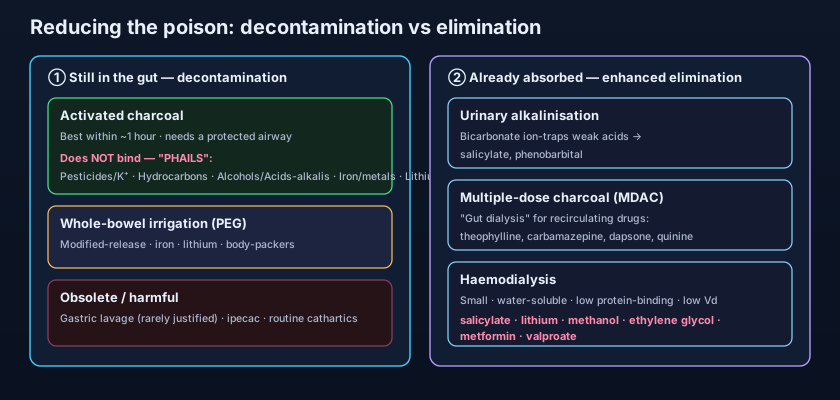
Activated charcoal is carbon that has been steam- or chemical-treated to riddle it with pores, giving a tiny amount an enormous internal surface area — hundreds of square metres per gram. Poured into the gut lumen, that vast surface adsorbs (grips onto its surface) many drug molecules before they can cross the gut wall, trapping them so they pass out in the stool instead of into the blood. It kills nothing and neutralises nothing chemically; it simply holds the poison. Its value is highest early, because it can only catch drug that is still in the lumen. As a rule of thumb, a single dose gives its best return within about an hour of ingestion — after that, more and more of the drug has already been absorbed and there is progressively less to bind. A cooperative, awake patient can drink it; the dose is weight-based and the same slurry serves most poisonings that charcoal can help.
Think of activated charcoal as a sponge with a microscopically crumpled surface, dropped into a river of poison. As long as the drug is still floating past in the current — the gut lumen — the sponge soaks it up and carries it away downstream. But once the drug has already soaked into the riverbank — been absorbed across the gut wall into the blood — the sponge is useless: it can only grab what is still in the water. That is the whole reason charcoal is a race against the clock, and why an hour late is a different situation from an hour early.
The great danger of charcoal is not the charcoal — it is the airway. Charcoal itself is inert, but getting it into a drowsy or convulsing patient is where the harm lives. If a patient with a depressed level of consciousness vomits and inhales the black slurry, the result is a charcoal aspiration pneumonitis that can be severe or fatal — a self-inflicted lung injury far worse than the poisoning it was meant to blunt. So charcoal is given only to a patient who can protect their own airway, or one already intubated with the airway secured. A stuporous overdose patient with no protected airway is precisely the wrong person to hand a cup of charcoal. It is also pointless in ileus or bowel obstruction, where nothing moves through the gut.
What charcoal does NOT bind — the high-yield list
Charcoal binds a wide range of organic drugs, but a crucial group of poisons it barely touches — and this is a favourite exam point, because reaching for charcoal here wastes time and gives false reassurance. The classic non-binders are the metals and iron; lithium; potassium; the alcohols, including the toxic alcohols methanol and ethylene glycol; hydrocarbons; and corrosives (strong acids and alkalis). A common way to remember them is the mnemonic PHAILS — Pesticides (organophosphates are a partial exception — charcoal does bind them), Hydrocarbons, Acids/Alkalis (corrosives), Iron and other metals including Lithium, and Solvents/alcohols. These are small, charged, or non-carbon molecules that the porous carbon surface simply cannot grip. For several of them — iron, lithium, the toxic alcohols — the answer lies elsewhere: whole-bowel irrigation, a specific antidote, or dialysis, all covered in the Iron, Lithium, and Enhanced-elimination & antidotes chapters.
- Decontamination reduces absorption of poison still in the gut — it is narrow and time-sensitive, never a reflex.
- The decision hinges on dose + timing + toxicity together; miss one and risk outweighs benefit.
- Activated charcoal adsorbs drug in the gut lumen; best value within ~1 hour of ingestion.
- Give charcoal only with a protected airway — aspiration pneumonitis is the real danger.
- Charcoal does NOT bind metals/iron, lithium, potassium, alcohols, hydrocarbons, or corrosives.
Whole-bowel irrigation: flushing the whole tube
When charcoal can't bind the poison, sometimes you flush it straight through. Whole-bowel irrigation (WBI) means giving large volumes of polyethylene glycol (PEG) electrolyte solution — the same osmotically balanced, non-absorbed laxative used to clear the bowel before colonoscopy, and the same PEG covered under osmotic laxatives in the Gastrointestinal section — often by nasogastric tube, until the rectal effluent runs clear. It does not adsorb anything; it mechanically washes the gut contents out from top to bottom before they can be absorbed. That makes it the go-to for exactly the situations charcoal cannot cover: sustained- or modified-release and enteric-coated tablets that keep releasing drug over hours; iron and lithium, which charcoal does not bind; and body-packers who have swallowed wrapped packets of illicit drugs. Its contraindications mirror charcoal's — it is unsafe in bowel obstruction, ileus, perforation, or an unprotected airway.
Awake patient, 45 minutes after a large paracetamol or amitriptyline overdose → single-dose activated charcoal (airway intact). Sustained-release verapamil, or an iron overdose showing tablets on the abdominal X-ray → whole-bowel irrigation, because charcoal is weak or useless here. A cocaine body-packer with intact packets and no obstruction → whole-bowel irrigation to move the packets through safely. A methanol or ethylene glycol ingestion → neither is worth much; the real treatment is fomepizole and haemodialysis, in the Enhanced-elimination & antidotes chapter. The method always follows the poison, never the other way round.
The abandoned methods — and why
The dramatic techniques that once defined poisoning care have been retired because trials showed they rarely change outcomes and often cause harm. Gastric lavage — passing a wide tube to wash out the stomach — is now reserved for the rare, extreme case (a recent, life-threatening ingestion of a drug not bound by charcoal), because it risks aspiration, oesophageal injury, and pushing tablets onward into the bowel, all for little proven benefit. Syrup of ipecac, once kept in every home to induce vomiting, is obsolete and considered dangerous: it delays charcoal, empties the stomach unreliably, can cause protracted vomiting, and turns disastrous if the poison is a corrosive or a hydrocarbon, where vomiting re-exposes the oesophagus or seeds the lungs. Cathartics (stimulant or saline laxatives) given to "speed the poison through" have no proven benefit and can cause fluid and electrolyte disturbance, so they too are no longer recommended as a decontamination method.
The whole field has moved from "empty the stomach" to "decide, then intervene selectively." The old reflex — lavage everyone, make them vomit — did net harm. The modern principle is quieter and harder: for most poisoned patients, the best decontamination is none at all, and good supportive care plus, where it exists, a specific antidote does far more than any tube. Reach for charcoal or WBI only when a real dose, a real time window, and a real toxicity line up. Everything else is just doing something to feel useful — and in toxicology, doing something is often how you hurt the patient.
Beyond the gut: skin, eyes, and lungs
Not every poison arrives by mouth. For dermal exposure — pesticides, corrosives, or other chemicals on the skin — decontamination means removing contaminated clothing and irrigating the skin with copious water, which both limits the patient's ongoing absorption and protects staff from secondary contamination. Ocular exposure to any chemical is an emergency treated by immediate, prolonged irrigation of the eye with water or saline, continued until the surface pH normalises, because minutes of delay decide whether the cornea survives. Inhalational exposure is decontaminated simply by removing the patient from the source into fresh air and giving oxygen and airway support. These external routes share the gut principle exactly: stop further exposure first, then treat what has already been absorbed.
- Whole-bowel irrigation uses PEG to flush the whole gut — the same osmotic agent as bowel prep.
- WBI is for modified/sustained-release and enteric-coated drugs, iron, lithium, and body-packers.
- Gastric lavage is rarely justified — real harm (aspiration, oesophageal injury), little benefit.
- Syrup of ipecac is obsolete and dangerous; cathartics have no proven role.
- External decontamination: remove clothing + irrigate skin/eyes with water; move from the source in inhalation.
- For most poisoned patients the best decontamination is none — supportive care and a specific antidote do more.
- Giving activated charcoal to a drowsy patient with an unprotected airway — the classic route to a fatal charcoal aspiration pneumonitis.
- Reaching for charcoal in an iron, lithium, or toxic-alcohol overdose — it does not bind them, and the delay costs the real treatment (WBI, antidote, or dialysis).
- Inducing vomiting or performing lavage as a reflex — obsolete, ineffective, and dangerous, especially with corrosives or hydrocarbons.
A patient arrives 30 minutes after a deliberate overdose of sustained-release lithium tablets, fully alert and haemodynamically stable. Which decontamination approach is most appropriate?
- GI decontamination reduces absorption of poison still in the gut; it is narrow and time-sensitive, decided by dose + timing + toxicity, never a reflex.
- Activated charcoal adsorbs many drugs in the gut lumen, best within ~1 hour and only with a protected airway; it does NOT bind metals/iron, lithium, potassium, alcohols, hydrocarbons, or corrosives.
- Whole-bowel irrigation with PEG flushes the gut for modified-release drugs, iron, lithium, and body-packers — the situations charcoal cannot cover.
- Gastric lavage, syrup of ipecac, and cathartics are abandoned as harmful or useless; for most poisoned patients good supportive care and a specific antidote beat any decontamination.
- Goldfrank's Toxicologic Emergencies — Techniques used to prevent gastrointestinal absorption.
- Rang & Dale's Pharmacology — Principles of toxicology and the poisoned patient.
- Katzung's Basic & Clinical Pharmacology — Management of the poisoned patient.
- AACT / EAPCCT Position Statements: Single-Dose Activated Charcoal; Whole Bowel Irrigation; Gastric Lavage; Ipecac Syrup (updated positions). Clinical Toxicology.
- BNF / BNF for Children — Emergency treatment of poisoning; activated charcoal.
- UpToDate / TOXBASE — Gastrointestinal decontamination of the poisoned patient.