
Enhanced Elimination and the Logic of Antidotes
Decontamination tries to stop a poison getting in. But what do you do once it is already absorbed — coursing through the blood, distributing into tissue? Two very different tools answer that question. The first is enhanced elimination: clever tricks of chemistry and dialysis that pull the toxin out faster than the body could manage alone. The second is the antidote — a specific molecular counter-move that neutralises the poison or its mechanism. Both are seductive, and both are far rarer than students expect. For the overwhelming majority of poisonings, the treatment that saves the patient is not a magic reversal agent at all, but meticulous supportive care.
A 19-year-old is brought in after swallowing a bottle of aspirin. She is breathing fast and deep, her ears ringing, drenched in sweat. Blood gases show the strange fingerprint of salicylate: a respiratory alkalosis and a metabolic acidosis at the same time. Her salicylate level is climbing. The team does three things at once. They flood her with intravenous fluids and start an infusion of sodium bicarbonate — not to correct the pH of her blood, but to make her urine alkaline, so the drug she has already absorbed cannot crawl back out of the kidney. They watch the level. And they ask the question that decides everything: is she sick enough, is the level high enough, that draining the blood directly through a dialysis machine is now the safer path? There is no antidote for aspirin. Her survival will come from moving the poison, not neutralising it.
When decontamination is too late
Once a poison is in the blood, the gut is no longer the battlefield. The Decontamination chapter deals with poison still sitting in the gut — the window where activated charcoal or, rarely, washing out the bowel can still stop absorption. Enhanced elimination begins where that window closes: the toxin is already absorbed and distributed, and the only way to lower the body burden is to speed up its exit. Every technique here leans on a single truth borrowed from the Principles of Pharmacology chapter — that a drug's fate is governed by its pharmacokinetics. Its volume of distribution (Vd), how tightly it binds plasma protein, its water solubility, and its molecular size decide whether any of these tricks can touch it. Get the pharmacokinetics right and the choice of method almost makes itself.
Ion trapping: alkalinising the urine
The kidney filters a drug into the urine, but the story does not end there. Along the tubule, any drug that is uncharged and lipid-soluble can slip back across the membrane and be reabsorbed into the blood — undoing the kidney's work. A charged, ionised molecule cannot make that crossing; it is trapped in the tubular fluid and swept out. Here is the lever: a weak acid is ionised in an alkaline environment. Raise the urine pH by infusing sodium bicarbonate and a weak-acid drug becomes ionised the moment it is filtered, so it can no longer be reabsorbed — it is trapped in the urine and eliminated. This is ion trapping, and it is the same acid–base logic taught in the Principles of Pharmacology chapter, turned into a treatment.
Think of the tubule as a one-way turnstile that only lets people through if they are travelling light. A neutral, fat-soluble drug is travelling light — it strolls back through the turnstile into the blood. Alkalinising the urine is like forcing the drug to check a heavy, awkward suitcase (an electric charge) at the gate: now it is too laden to slip back through, and the only way out is forward, down the drain. You have not changed how much you filter — you have changed whether what you filtered can sneak back in.
The classic beneficiary is salicylate (aspirin), a weak acid. Urinary alkalinisation both traps salicylate in the urine and, by keeping the blood alkaline, drives the drug out of the brain — a double benefit, since central nervous system salicylate is what kills. Phenobarbital, another weak acid, can respond too, though multiple-dose charcoal is usually preferred for it. The mirror-image manoeuvre — acidifying the urine to trap weak bases like amfetamines — is described in textbooks but essentially abandoned, because the acid load is dangerous and the benefit marginal. Salicylate is the exam answer and the real-world workhorse; the Salicylate chapter follows the whole management through in detail.
Gut dialysis: multiple-dose activated charcoal
Charcoal is not only for the poison still in the gut — it can pull poison out of the blood. A single dose of activated charcoal is a decontamination tool: it binds poison sitting in the stomach and bowel before it is absorbed. Multiple-dose activated charcoal (MDAC) does something cleverer. Given repeatedly, charcoal keeps the gut lumen loaded with binder, so it can capture drug that diffuses back from the blood into the intestine — or that the liver excretes into bile and dumps into the gut. Some drugs recirculate this way (enterohepatic and enteroenteric recycling), and each time the drug re-enters the gut, the waiting charcoal grabs it and the drug leaves in the stool instead of being reabsorbed. The blood is effectively being cleansed across the gut wall, which is why MDAC is nicknamed "gut dialysis."
The evidence-supported list is short and worth memorising by its mnemonic-friendly members: theophylline, carbamazepine, phenobarbital, dapsone, and quinine. What they share is either enterohepatic/enteroenteric recirculation or slow, sustained-release absorption that MDAC can keep intercepting. Two non-negotiable cautions: MDAC demands a protected, working airway (charcoal aspirated into the lungs is a disaster), and it is useless — even harmful — in an ileus or bowel obstruction, where the charcoal has nowhere to go. It also does nothing for poisons charcoal cannot bind, such as iron, lithium, and alcohols.
- Enhanced elimination is for poison already absorbed; decontamination is for poison still in the gut.
- Ion trapping: alkalinising the urine ionises weak acids (salicylate, phenobarbital) so they can't be reabsorbed.
- Urinary alkalinisation is the workhorse for salicylate — it also pulls the drug out of the CNS.
- MDAC ("gut dialysis") suits drugs with enterohepatic/enteroenteric recycling: theophylline, carbamazepine, phenobarbital, dapsone, quinine.
- MDAC needs a protected airway and a working gut — never in ileus or obstruction.
- Charcoal (single or multiple dose) does not bind iron, lithium, or alcohols.
Haemodialysis: when the pharmacokinetics say yes
A dialysis membrane is a sieve, and only certain molecules fit through it. Haemodialysis passes the patient's blood across a semipermeable membrane and can strip out a toxin directly — but only if the toxin's pharmacokinetics allow it. Four properties decide dialysability. The molecule must be small enough to cross the membrane. It must be water-soluble, so it stays in the plasma where the machine can reach it. It must be minimally protein-bound, because protein-bound drug is too bulky to filter and stays anchored in the blood. And above all it must have a low volume of distribution (Vd) — a drug with a huge Vd has fled the blood and hidden deep in fat and tissue, so cleaning the blood barely dents the total body burden. Get all four and dialysis is transformative; miss even one and it is futile.
The toxins that fit the profile are worth knowing cold: salicylate, lithium, methanol and ethylene glycol (the toxic alcohols), metformin (for its lactic acidosis), and valproate in massive overdose. All are small, water-soluble, and low-Vd. Notice who is absent: tricyclic antidepressants and digoxin are huge-Vd, tissue-bound drugs — dialysis is pointless for them no matter how sick the patient. The modern, evidence-based version of "who should be dialysed" comes from the EXTRIP workgroup (Extracorporeal Treatments in Poisoning), which turned expert consensus into graded, poison-by-poison recommendations. The Lithium and Toxic-alcohol chapters lean on EXTRIP directly.
The single most useful number in enhanced elimination is the volume of distribution. If a drug's Vd is small (it stays in the blood), extracorporeal removal — dialysis — can work. If the Vd is enormous (it hides in tissue), the blood holds only a trickle of the total, and no amount of dialysing the blood will help; you need an antidote that reaches the tissue compartment, or simply time and support. This is exactly why digoxin (Vd huge) is answered with Fab antibody fragments rather than dialysis, while lithium (Vd small) is answered with dialysis. The pharmacokinetics chooses the tool.
The antidote concept: a specific counter-move
An antidote is a drug that specifically opposes a poison — by blocking its receptor, blocking its conversion into a toxic metabolite, reactivating the enzyme it disabled, binding it into an inert complex, or replenishing what it depleted. True antidotes are precious and few. The temptation is to picture toxicology as a shelf of reversal agents, one per poison. The reality is the opposite: for most poisonings there is no antidote at all, and the patient is saved by airway, breathing, circulation, fluids, and time. When an antidote does exist, understanding its mechanism tells you its indication, its limits, and its dangers far better than memorising a dose. It helps to group them by how they work.
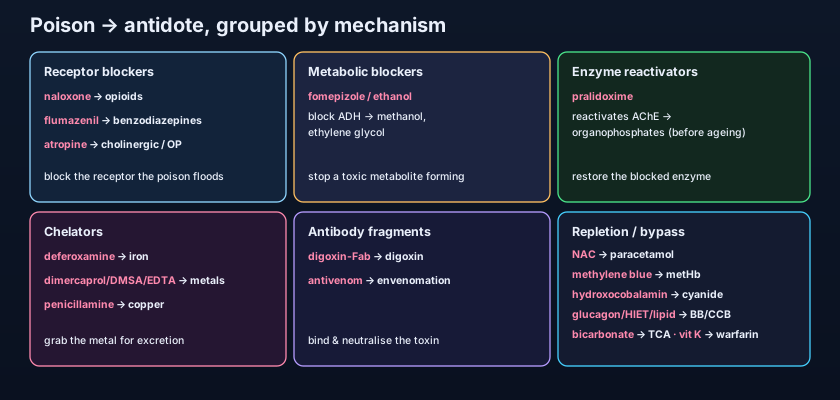
Six mechanism families cover almost every antidote worth knowing. First, receptor antagonists, which simply displace the poison from its receptor: naloxone reverses opioids at the mu receptor, flumazenil reverses benzodiazepines at the GABA receptor, and atropine blocks muscarinic receptors flooded with acetylcholine in organophosphate poisoning. Second, metabolic blockers, which stop a harmless parent compound being turned into a toxic metabolite: fomepizole blocks alcohol dehydrogenase (ADH), so methanol and ethylene glycol are never converted into the acids that blind and kill. Third, enzyme reactivators: pralidoxime prises the organophosphate off acetylcholinesterase (AChE) and restores the enzyme — but only if given before the bond "ages" into permanence. Fourth, chelators, which grip a metal into an inert, excretable complex: deferoxamine for iron, dimercaprol and its relatives for arsenic, lead, and mercury. Fifth, antibody fragments, which physically bind the toxin: digoxin-specific Fab fragments mop up digoxin, and antivenom neutralises snake and scorpion venoms. Sixth, metabolic bypass and repletion, which restore a pathway the poison crippled: N-acetylcysteine (NAC) replenishes glutathione in paracetamol overdose, methylene blue reduces methaemoglobin (metHb) back to functioning haemoglobin, hydroxocobalamin binds cyanide, glucagon and high-dose insulin euglycaemic therapy (HIET) rescue the beta-blocker- or calcium-channel-blocker-poisoned heart, and intravenous lipid emulsion soaks up fat-soluble drugs from an arrested circulation.
- Dialysability needs all four: small size, water-soluble, low protein binding, low Vd.
- The dialysable list: salicylate, lithium, methanol/ethylene glycol, metformin, valproate (EXTRIP-guided).
- High-Vd drugs (TCAs, digoxin) are NOT dialysable — reach them with antidotes or time, not the machine.
- Antidotes cluster into six mechanisms: receptor block, metabolic block, enzyme reactivation, chelation, antibody binding, repletion/bypass.
- Fomepizole blocks ADH before the toxic acids form; pralidoxime reactivates AChE before ageing; NAC restores glutathione.
- Antidotes are the exception. For most poisonings, supportive care is the treatment.
- Giving flumazenil blindly to a drowsy overdose patient. In a benzodiazepine-dependent patient or a mixed overdose with a tricyclic, it can precipitate uncontrollable seizures — the reversal is far more dangerous than the sedation.
- Treating cocaine chest pain with a non-selective beta-blocker. Blocking beta while alpha runs free leaves "unopposed alpha" vasoconstriction that worsens coronary spasm and hypertension.
- Assuming an antidote exists for every poison — or waiting for one. Delaying airway, breathing, circulation and dialysis while hunting for a reversal agent kills patients who would have survived on supportive care alone.
A patient presents with a large lithium overdose: level markedly elevated, worsening confusion and tremor, and rising creatinine. Which approach is most appropriate to lower the body burden?
- Enhanced elimination speeds an already-absorbed poison out: ion trapping (urinary alkalinisation) for weak acids like salicylate, MDAC for gut-recirculating drugs, and haemodialysis for small, water-soluble, low-Vd, low-protein-bound toxins.
- The dialysable list — salicylate, lithium, methanol/ethylene glycol, metformin, valproate (the EXTRIP concept); high-Vd, tissue-bound drugs like TCAs and digoxin are not dialysable.
- Antidotes fall into six mechanism families: receptor antagonists (naloxone, flumazenil, atropine), metabolic blockers (fomepizole), enzyme reactivators (pralidoxime), chelators (deferoxamine, dimercaprol), antibody fragments (digoxin-Fab, antivenom), and repletion/bypass (NAC, methylene blue, hydroxocobalamin, glucagon, HIET, lipid emulsion).
- Both are the exception, not the rule — for most poisonings the pharmacokinetics (Vd, protein binding, size) decide what's possible, and supportive care is what saves the patient.
- Goldfrank's Toxicologic Emergencies — Principles of managing the poisoned patient; enhanced elimination and antidotes in depth.
- Rang & Dale's Pharmacology — Drug elimination, pharmacokinetics, and the basis of ion trapping.
- Katzung Basic & Clinical Pharmacology — Management of the poisoned patient; antidotes by mechanism.
- EXTRIP (Extracorporeal Treatments in Poisoning) Workgroup recommendations — salicylate, lithium, toxic alcohols, metformin, valproate.
- American Academy of Clinical Toxicology / EAPCCT position statements — single-dose and multiple-dose activated charcoal, urinary alkalinisation.
- UpToDate / TOXBASE — Enhanced elimination techniques and antidote indications.