
The Anatomical Position, Planes and the Language of the Body
Imagine trying to give someone directions in a city where no one has agreed which way is north. "Turn left" is useless if we're facing opposite ways. Anatomy solved this problem centuries ago by inventing a shared map: one agreed starting posture, three imaginary slicing planes, and a set of paired words that never change their meaning. Learn it once and a surgeon in Baghdad and a surgeon in Boston mean exactly the same thing when they say "the nerve runs medial to the artery." This is the grammar beneath every page of the atlas — master it, and the rest of anatomy stops being memorization and starts making sense.
A patient lies unconscious on a trolley, curled on their right side, one arm flung above the head, the other tucked under the chest. The emergency team must describe a stab wound with total precision down the phone to the surgeon upstairs. They do not say "it's on the upper part, near where his arm is now." They say: "a 3-centimetre wound, anterior chest wall, just medial to the left nipple, in the fifth intercostal space." Every one of those words is measured not from how the body is lying, but from an imaginary, upright, forward-facing figure that everyone in medicine carries in their head. The patient is crumpled on a trolley — but anatomically, they are standing to attention. That shared imaginary posture is where all of anatomy begins.
The anatomical position: the agreed zero point
Before you can describe anything, everyone must start from the same posture. The anatomical position is a specific, agreed pose: standing upright, head and eyes facing forward, feet together and flat on the ground, arms hanging by the sides — and, crucially, the palms turned forward so the thumbs point away from the body. Every anatomical term of location is defined relative to this position, no matter how the real patient is actually lying, sitting or twisted. This is why the words are unambiguous: "in front of" always means the same surface of the body, even for a patient lying face-down. The forward-facing palm is not a trivial detail — it is the whole reason the two bones of the forearm, the radius and ulna, are described as lying side by side and "uncrossed." Rotate the palm to face backward and the radius crosses over the ulna; anatomy freezes the palm forward so the bones always have a fixed relationship to name.
Think of the anatomical position as the "home" key on a keyboard, or true north on a compass. A compass needle is useless unless everyone agrees where north is; "three streets east" only works if east is fixed. In the same way, terms like superior, medial and anterior only carry meaning because they are all measured from one frozen, upright reference figure. The patient may be upside down on an operating table, but the map in the anatomist's head never rotates.
The three planes: how we slice the body
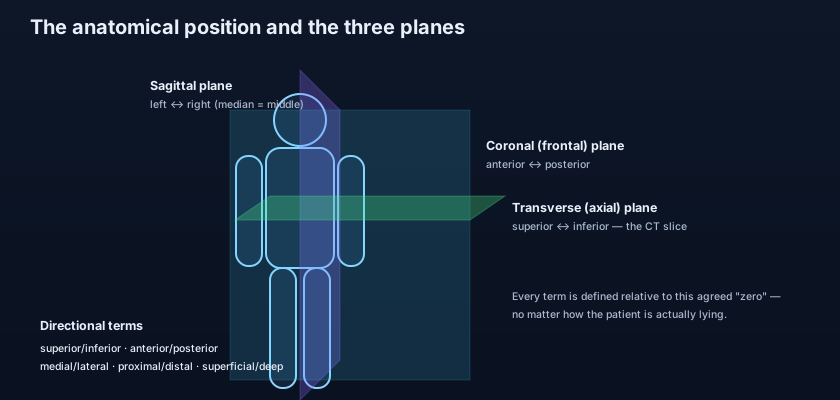
To describe a cut, an image or a section, we need imaginary flat sheets passing through the body. There are three cardinal planes, each at right angles to the other two. The sagittal plane runs vertically from front to back and divides the body into left and right; the special one that passes exactly down the midline — through the tip of the nose and the navel — is the midsagittal or median plane. The coronal (frontal) plane also runs vertically but divides the body into front and back (anterior and posterior); imagine the plane of a door you are standing against. The transverse (axial, or horizontal) plane cuts across the body into upper and lower parts — this is the plane of a single CT slice. Any plane that is slanted, cutting at an angle rather than cleanly along one of these three, is called an oblique plane, and in reality most real-world sections are at least a little oblique.
Next time you see a CT or MRI scan on a screen, you are looking at these planes made real. The classic "doughnut ring" image of the abdomen — a circle with the spine at the back and organs arranged inside — is a transverse (axial) slice, exactly the plane the CT scanner sweeps through the body. A profile view showing the face, spine and brain in one image is a midsagittal section. Radiology is, quite literally, anatomy sliced along the three planes and photographed.
Terms of location: the world in opposite pairs
The directional vocabulary is built almost entirely from opposite pairs, which makes it easy to learn. Superior means nearer the head, inferior nearer the feet. Anterior (or ventral) is toward the front, posterior (or dorsal) toward the back. Medial means closer to the midline, lateral farther from it — the eyes are medial to the ears. For the limbs there is a second pair: proximal means nearer the point where the limb joins the trunk, distal farther away — the elbow is proximal to the wrist. Depth has its own pair: superficial means nearer the skin, deep means farther in — the skin is superficial to the muscle, which is deep to it. These relationships are absolute in the anatomical position, which is why the muscle that moves a joint can always be described precisely against the bone it pulls on.
The hand and foot get their own special terms, because "anterior" and "posterior" become confusing once the palm can turn. The front of the hand is the palmar (or volar) surface; the back of the hand and the top of the foot are both the dorsum. The sole of the foot is the plantar surface — the same root as "plantar fasciitis," the inflamed sole that plagues runners. This layered arrangement of skin over fascia over muscle over bone is the same everywhere in the body; the way those four basic tissues stack and the way skin and fascia wrap the deeper structures is described using exactly these superficial-to-deep terms.
- The anatomical position — upright, facing forward, feet together, palms forward — is the fixed reference for every term.
- Terms hold true regardless of how the patient is actually lying or sitting.
- Three cardinal planes: sagittal (left/right), coronal/frontal (front/back), transverse/axial (upper/lower).
- Midsagittal (median) splits the body into equal left and right halves; oblique is any slanted plane.
- A CT/axial slice is a transverse section — radiology is anatomy cut along these planes.
- Location terms come in opposite pairs: superior/inferior, anterior/posterior, medial/lateral, proximal/distal, superficial/deep.
Terms of movement: the verbs of the joints
If the location terms are the body's nouns, the movement terms are its verbs. Movements are named for what a joint does relative to the anatomical position, and again they come mostly in pairs. Flexion decreases the angle at a joint (bending the elbow), extension increases it (straightening it). Abduction moves a limb away from the midline (raising the arm out to the side), adduction brings it back toward the midline — remember it as "adding" the limb back to the body. Rotation spins a bone around its long axis: medial (internal) rotation turns the front of the limb toward the midline, lateral (external) rotation turns it away. String flexion, abduction, extension and adduction together in a smooth circle and you get circumduction — the cone your arm traces when you draw a big circle in the air. All of these happen at joints, and every one of them is produced by a muscle pulling across that joint.
Some movements are unique to particular regions and worth naming precisely. Pronation and supination describe the forearm and hand: supination turns the palm to face up, pronation turns it to face down. A simple memory hook is soup — you supinate to hold a bowl of soup steady in your palm, and pronate to pour it out. Inversion turns the sole of the foot inward to face the other foot, eversion turns it outward; the classic "twisted ankle" is a violent inversion injury. Dorsiflexion lifts the foot up at the ankle (standing on your heels), plantarflexion points the toes down (standing on tiptoe). And opposition is the beautiful, almost uniquely human movement of the thumb tip reaching to touch the tip of another finger — the pincer grip that lets us hold a pen, thread a needle and build a civilization.
Watch what your arm does to lift a cup of coffee to your mouth. You flex the elbow to bend it, supinate the forearm slightly so the cup stays level, oppose the thumb against the fingers to grip the handle, and the whole limb stays adducted close to the trunk. Set the cup down and pour, and you pronate to tip it. A single sip strings together flexion, supination, opposition and adduction — four precise anatomical verbs describing what a toddler does without a single thought.
- Flexion/extension bend and straighten a joint; abduction/adduction move a limb from and toward the midline.
- Medial and lateral rotation spin a bone on its long axis; circumduction is a continuous cone of movement.
- Supination turns the palm up (holding soup); pronation turns it down (pouring it).
- Inversion/eversion turn the sole in and out; dorsiflexion/plantarflexion lift and point the foot.
- Opposition brings the thumb to the fingertips — the grip behind almost all fine human tasks.
- Every movement happens at a joint and is driven by muscles pulling across it.
- Describing terms from the patient's real posture instead of the anatomical position — "anterior" is fixed, even for someone lying face-down.
- Confusing the coronal and sagittal planes: sagittal divides left from right, coronal divides front from back.
- Mixing up pronation and supination — supination is palm-up (holding), pronation is palm-down (pouring).
A radiologist describes a tumour as best seen on an axial slice. Which plane are they viewing, and how does it divide the body?
- The anatomical position (upright, facing forward, palms forward) is the fixed zero point every term is measured from, whatever the patient's real posture.
- Three cardinal planes — sagittal (left/right), coronal (front/back), transverse/axial (upper/lower, the CT slice) — plus median (true midline) and oblique (slanted).
- Location terms come in opposite pairs: superior/inferior, anterior/posterior, medial/lateral, proximal/distal, superficial/deep, plus palmar/plantar/dorsum for hand and foot.
- Movement terms — flexion/extension, abduction/adduction, rotation, circumduction, pronation/supination, inversion/eversion, dorsiflexion/plantarflexion, opposition — name what joints do, all driven by muscles.
- Drake RL, Vogl AW, Mitchell AWM. Gray's Anatomy for Students — Introduction: terminology, the anatomical position and planes.
- Moore KL, Dalley AF, Agur AMR. Clinically Oriented Anatomy — Introduction to Clinical Anatomy.
- Standring S (ed). Gray's Anatomy: The Anatomical Basis of Clinical Practice.
- Snell RS. Clinical Anatomy by Regions — Introduction: basic anatomical terminology.
- Netter FH. Atlas of Human Anatomy — orientation plates.
- TeachMeAnatomy — Anatomical Terminology: terms of location, planes and movement.