
The Four Tissues: The Body's Building Materials
A medieval cathedral — soaring, intricate, seemingly infinite in its detail — is built from a mere handful of materials: stone, timber, glass, lead. Rearrange the same few things and you get a wall, an arch, a window, a spire. Your body plays exactly this trick. Every organ you own — the delicate lace of a lung, the muscled fist of the heart, the folded landscape of the brain — is assembled from just FOUR basic tissue types. Learn those four, and the whole of anatomy stops being a list to memorize and becomes a set of variations on a theme.
Take a scalpel to any organ and, under the microscope, the illusion of infinite variety dissolves. A slice of gut, a slice of kidney, a slice of skin — at first they look like different worlds. But keep looking. Everywhere you find the same four fabrics, cut and folded into new shapes: a covering sheet of cells here, a packing of fibres there, a bundle of contracting strands, a web of signalling wires. The body is not built from thousands of unique materials. It is built, over and over, from four. A tissue is simply a community of cells that share a job — and organs are what you get when these communities are stitched together. This is the first and deepest lesson in anatomy: master the materials before you study the building.
The ladder of life: from cell to organism
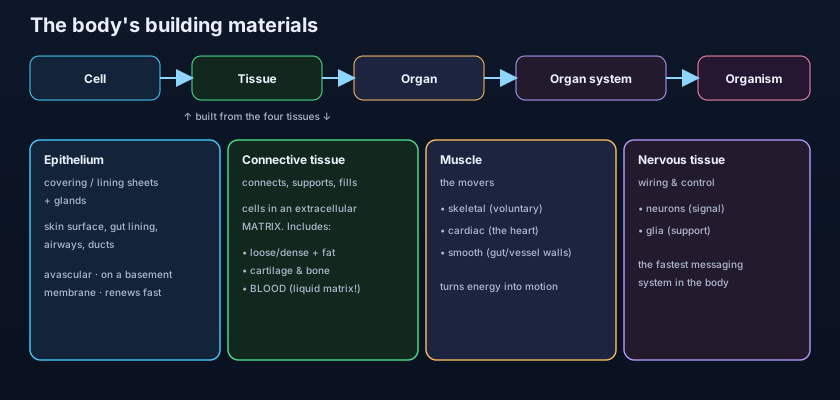
The body is organized in nested levels, each built from the one below it. Anatomy climbs a ladder. At the bottom sits the cell — the smallest living unit. Gather many cells of a kind, with the material they secrete around them, and you have a tissue. Combine two or more tissues into a structure with a defined job and you have an organ: the stomach, the femur, the eye. Link several organs that cooperate toward one grand function and you have an organ system — the digestive system, the skeletal system, the nervous system. And all the systems working together, in one living whole, make the organism: you. Every rung is built from the rung below, and the tissue rung is the one where the body's four fundamental materials first appear.
Tissue one — Epithelium: the body's wallpaper
Wherever the body meets the outside world — or lines a hollow space — you find epithelium. Epithelium (النسيج الظهاري, Epithelium) is a sheet of cells packed so tightly they leave almost no gap between them, like tiles set edge to edge. It has three jobs — to cover, to line, and to secrete: it forms the outer surface of the skin, lines the inside of the gut, the airways and the blood vessels, and builds the glands that pour out saliva, sweat, acid and hormones. Anatomists name each epithelium two ways at once — by its layers and by its cell shape. Layers: simple (a single layer, for absorption and exchange, as in the gut and the air sacs of the lung) or stratified (many layers stacked for protection, as in the skin and mouth). Shape: squamous (flat, like floor tiles), cuboidal (cube-like), or columnar (tall pillars). So the lining of your intestine is "simple columnar," and your epidermis is "stratified squamous" — the name alone tells you both its build and its purpose.
Two features define how epithelium lives. First, it is avascular — no blood vessel enters it — so every epithelial cell must feed by diffusion from below, resting on a thin, tough sheet called the basement membrane that glues it to the tissue underneath. Second, because it sits on the front line and takes constant wear, it renews relentlessly: the lining of your gut is shed and completely replaced every few days, and the outer skin sheds and rebuilds over weeks. Stop and consider that — the surface reading these words is not the surface you were born with, nor even the one you had last month. You are, at your boundaries, perpetually new. Epithelium and its supporting layers are explored in living detail in the skin and fascia.
Tissue two — Connective tissue: the mortar and scaffold
If epithelium is the wallpaper, connective tissue is everything holding the house together. Connective tissue (النسيج الضام, Connective tissue) is by far the most diverse of the four, and its jobs are written in its name and more — it connects, supports, binds and fills. Its defining trick is unique among tissues: its cells are not packed together but scattered, sparse, living inside a sea of material they secrete around themselves — the extracellular matrix. That matrix — a blend of protein fibres (collagen for strength, elastin for stretch) set in a ground substance — is the real substance of the tissue. Change the recipe of the matrix and you travel the entire connective-tissue spectrum: make it soft and gel-like and you get loose connective tissue, the packing that fills the spaces between organs; pack it with dense collagen and you get the tough cords of tendons and ligaments; load it with fat-storing cells and you get adipose tissue, the body's fuel depot and insulation.
Keep hardening the matrix and the story gets grander. Add firm but flexible fibres and you get cartilage — the smooth, gristly cushion capping your joints and shaping your ear and nose. Mineralize it with calcium salts and you get bone, connective tissue turned to living rock, whose architecture is the subject of bones and their structure. And then comes the fact that catches every student off guard: blood is a connective tissue too. It fits the definition perfectly — scattered cells (red cells, white cells, platelets) suspended in an extracellular matrix. Its matrix simply happens to be liquid: the plasma. A tissue you can pour into a tube is still, by its architecture, a cousin of bone. Where those blood cells are born and how drugs act on that production is the story of blood formation and its drug targets.
Think of a brick building. The bricks facing you — the visible, sealed outer surface — are the epithelium: a continuous skin of tiles. Everything you don't see is connective tissue: the mortar packed between the bricks, the timber scaffold, the steel beams, the foam insulation stuffed in the walls, even the water in the pipes. One family of material, tuned soft or hard, wet or dry, does all the connecting, cushioning, supporting and filling. And the "extracellular matrix" is simply the anatomical name for that mortar — the stuff between the cells that, in connective tissue, matters more than the cells themselves.
Tissue three — Muscle: the movers
Only one tissue can shorten on command — and every movement you make depends on it. Muscle tissue (النسيج العضلي, Muscle tissue) is built from long cells packed with protein filaments (actin and myosin) that slide over one another to make the cell contract. That single ability — to shorten and pull — is the source of every movement in the body, from a sprint to a heartbeat to the quiet squeeze that moves food along your gut. It comes in three flavours. Skeletal muscle attaches to bones, is under voluntary control, and appears striated (finely striped) under the microscope — this is the meat that bends your elbow and lets a dancer hold a pose. Cardiac muscle builds the wall of the heart alone; it is also striated but involuntary, contracting tirelessly, on its own rhythm, some three billion times in a lifetime without your ever thinking about it. Smooth muscle lines the walls of hollow organs — the gut, the bladder, the blood vessels, the airways — is involuntary and un-striated, and does the slow, unseen work of pushing, squeezing and narrowing. How skeletal muscle turns contraction into motion across joints is the whole of muscle and movement.
Tissue four — Nervous tissue: the wiring
The last tissue doesn't cover, support or move — it computes and commands. Nervous tissue (النسيج العصبي, Nervous tissue) is the body's information network, and it is made of two cell populations. The neurons are the signallers: long, branching cells that generate and race electrical impulses along themselves and pass them, chemically, to the next cell. They are the wires and switches that let you feel a touch, decide to move, and fire the command to the muscle a hundredth of a second later. Around and among them lie the glia — a far larger crowd of support cells that insulate the wires, feed the neurons, defend against infection and hold the whole delicate network in place. Together, neurons and glia build the brain, the spinal cord and every nerve threading out to the tissues. This tissue, gathered into an organ system, becomes the master controller mapped out in the nervous system's grand plan — and it is the target of some of medicine's most powerful drugs.
Here is the elegant symmetry hidden in the four. Two tissues are cellular — their cells crammed together with almost nothing between them: epithelium (packed for covering) and muscle (packed for pulling). The other two are defined by what lies between the cells: connective tissue by its extracellular matrix, and nervous tissue by the vast, communicating web its cells form. And notice the division of labour: epithelium and connective tissue build and hold the body; muscle and nervous tissue act on it. Structure and control — the whole of physiology, foreshadowed in four fabrics.
You already know these tissues from your own scrapes. A blister is fluid that has collected between the layers of the epidermis — a pocket opening within stratified squamous epithelium after friction. A bruise is bleeding into the loose connective tissue under the skin, the trapped blood (itself a connective tissue) slowly changing colour as it is broken down. A pulled hamstring is torn skeletal muscle. And the tingle of banging your "funny bone" is nervous tissue complaining directly — you have struck the ulnar nerve where it runs exposed behind the elbow, and pressing a bundle of neurons sends a jolt straight down to your little finger. One more, tying two tissues together: scar tissue. When a deep wound heals, the body cannot always rebuild the original tissue, so it patches the gap with dense connective tissue — strong, but stiff and without the structure it replaced. That is why a scar looks and behaves differently from the skin around it.
- The body climbs a ladder: cell → tissue → organ → organ system → organism.
- Every organ is built from just FOUR basic tissues: epithelium, connective, muscle, nervous.
- Epithelium covers, lines and secretes; it is avascular, sits on a basement membrane, and renews constantly.
- Epithelium is named by layers (simple/stratified) and cell shape (squamous/cuboidal/columnar).
- Connective tissue connects, supports and fills — cells scattered in an extracellular matrix.
- The connective spectrum runs from loose tissue and fat, to cartilage and bone, to blood (a liquid-matrix connective tissue).
- Muscle contracts (actin/myosin sliding): skeletal (voluntary, striated), cardiac (involuntary, striated), smooth (involuntary, un-striated).
- Skeletal muscle moves bones; cardiac muscle is heart-only; smooth muscle lines hollow organs and vessels.
- Nervous tissue = neurons (signal) + glia (support); it wires and controls the body.
- Two tissues are cellular (epithelium, muscle); two are defined by what lies between the cells (connective, nervous).
- Build-and-hold: epithelium + connective. Act-and-control: muscle + nervous.
- Everyday proof: a blister (epithelium), a bruise (connective), a strain (muscle), a funny-bone jolt (nervous).
- Thinking blood is not a tissue. Blood is a connective tissue — scattered cells in a liquid matrix (plasma) — and so, at their core, are bone and cartilage.
- Confusing cardiac muscle with skeletal because both are striated. Cardiac muscle is involuntary; only skeletal muscle is under conscious control.
- Assuming glands are a separate tissue. Glands are made of epithelium — secretion is one of epithelium's three core jobs, alongside covering and lining.
A student is told that a certain tissue consists of sparse cells suspended in a liquid extracellular matrix. Which tissue best fits this description?
- The body is organized in levels — cell → tissue → organ → organ system → organism — and every organ is built from just four basic tissues.
- Epithelium covers, lines and secretes (avascular, on a basement membrane, ever-renewing); connective tissue connects and supports via cells in an extracellular matrix — from fat and cartilage to bone and even blood.
- Muscle contracts (skeletal, cardiac, smooth) to produce all movement; nervous tissue (neurons + glia) wires and controls the body.
- Two tissues build and hold (epithelium, connective); two act and control (muscle, nervous) — the whole body is variations on these four materials.
- Gray's Anatomy for Students (Drake, Vogl, Mitchell) — Introduction: cells, tissues and the levels of organization.
- Moore's Clinically Oriented Anatomy — Introduction to clinical anatomy: tissues and systems.
- Junqueira's Basic Histology: Text and Atlas — Epithelial, connective, muscle and nervous tissue.
- Ross and Pawlina, Histology: A Text and Atlas — The four basic tissues.
- Netter's Atlas of Human Anatomy — General plan of the body.
- TeachMeAnatomy — The Basic Tissue Types.