
The Nervous System Plan: The Body's Wiring
Every other system in the body is slow. Blood takes a minute to loop the whole body; a hormone can take hours to act. The nervous system works in thousandths of a second. It is the fastest thing you own — a living wiring diagram of roughly 86 billion neurons that lets you flinch, balance, breathe, remember, and read this sentence. This article is the map of that wiring: not the fine detail of the brain's valleys and nuclei — those get their own chapters — but the master plan. Where the wires run, what carries information in and what carries commands out, and why part of the system runs your heart and gut without ever asking your permission.
Your hand touches a hot pan. Before you have consciously felt anything — before the word "hot" has formed anywhere in your mind — your arm is already pulling back. The muscle has moved and the hand is safe, and only a heartbeat later does the pain arrive to explain what happened. That gap is not a glitch. It is the nervous system revealing its architecture: a fast local loop in the spinal cord acted first, and your brain was informed afterwards. A signal can race down a large nerve fibre at up to about 120 metres per second — faster than a Formula 1 car. In the time it takes to read this sentence, billions of these signals have crossed your body, most of them without your knowledge, keeping your heart beating, your gut moving, your pupils tuned to the light. This is the story of how all of that is wired.
Two divisions: the centre and the cables
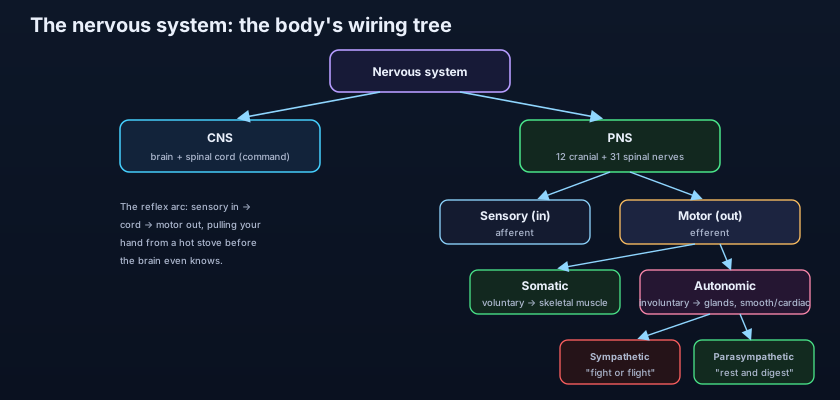
Everything in the nervous system belongs to one of two halves. The first is the central nervous system (CNS) — the brain and the spinal cord. This is the command centre and the processor: where signals are weighed, decisions are made, memories are stored, and commands are issued. The second is the peripheral nervous system (PNS) — every nerve outside the brain and cord, the cables that reach into every corner of the body. Two great sets of cables leave the centre: 12 pairs of cranial nerves that emerge directly from the brain to serve the head and neck (and, through the vagus, far beyond), and 31 pairs of spinal nerves that branch off the spinal cord between the vertebrae to serve the trunk and limbs. Nothing in the body is more than a nerve-ending away from this network — a scaffolding of bone and joint that the wiring both threads through and commands.
Think of a nation's telephone network. The CNS is the central exchange — the building full of switchboards where every call is routed and every decision made. The PNS is the millions of kilometres of cable and the handsets in every home and street, carrying the calls to and from that exchange. The cranial and spinal nerves are the main trunk lines leaving the building. Cut a cable and the exchange is intact but that street goes silent — which is exactly what happens when a nerve is severed while the brain remains perfectly healthy.
Information in, commands out
The peripheral cables run in two directions, and the direction is the whole point. Functionally, the PNS splits into a sensory division and a motor division. The sensory (afferent) side carries information IN — from skin, eyes, ears, joints, muscles and viscera up to the CNS. Afferent means "carrying toward" the centre: touch, temperature, pain, the position of your limbs in space, the stretch of your bladder. The motor (efferent) side carries commands OUT — from the CNS to the muscles and glands that act on the world. Efferent means "carrying away" from the centre. A useful memory: Sensory = Afferent = Arriving; Motor = Efferent = Exiting. Every reflex, every deliberate movement, every gut cramp is some combination of an arriving signal and a departing command.
The motor side splits: voluntary and involuntary
The motor division itself divides in two. The somatic nervous system is the part you command consciously: it drives skeletal muscle — the muscles that move your bones, walk you across a room, and shape the words you speak. When you decide to lift a cup, a somatic motor nerve carries that order to the muscle; how that muscle then contracts is the story of muscle and movement. The autonomic nervous system (ANS) is the part you do not command and mostly never notice: it runs the involuntary machinery — the glands, the smooth muscle of your gut and blood vessels, and the cardiac muscle of your heart. You cannot consciously will your stomach to digest or your arteries to constrict, and that is exactly the point: the autonomic system frees your conscious mind from having to run the body's housekeeping.
Fight or flight, rest and digest
The autonomic system runs on two opposing accelerators, always in balance. The ANS itself divides into two branches that pull in opposite directions. The sympathetic nervous system is the "fight or flight" system: it mobilises the body for action — heart racing, pupils widening, airways opening, blood shunted to muscle, digestion switched off. The parasympathetic nervous system is the "rest and digest" system: it does the calm, restorative opposite — heart slowing, pupils narrowing, gut churning, the body conserving and rebuilding. Almost every organ receives both, and its moment-to-moment state is the tug-of-war between them. This is where anatomy and pharmacology fuse: the two branches speak through different chemical messengers, so an enormous share of medicine works by nudging this balance. The whole logic — which branch does what, and how drugs tilt it — is the subject of fight-or-flight versus rest-and-digest.
The chemistry is the key that pharmacology turns. The sympathetic branch mostly signals through noradrenaline acting on adrenergic receptors; the parasympathetic branch, and every nerve-to-muscle junction, signals through acetylcholine acting on cholinergic receptors. Knowing which receptor sits on which organ tells you exactly what a drug will do — the map of it is the cholinergic versus adrenergic receptor map. The life cycles of those two transmitters, from manufacture to disposal, are told in acetylcholine's synthesis to breakdown and noradrenaline's synthesis to reuptake — and one of the heart's own autonomic controls is followed further in the cardiovascular plan.
The neuron: the single working unit
For all its scale, the whole network is built from one repeating cell: the neuron. It has three parts. The dendrites are the receiving branches, a bushy antenna that gathers incoming signals. The cell body (soma) holds the nucleus and does the living housekeeping, and is where the incoming signals are summed. The axon is the single long output cable — sometimes over a metre long, running from your spinal cord to your toe in one unbroken fibre — that carries the signal away as an electrical impulse. Where one neuron passes its message to the next, they do not actually touch: they meet at a synapse, a microscopic gap the electrical signal cannot leap. Instead the arriving axon releases a chemical — a neurotransmitter such as acetylcholine or noradrenaline — that drifts across the gap and speaks to the next cell. That single chemical step is the exact point at which most nervous-system drugs do their work.
This is why nerve drugs are so precise. A local anaesthetic works by silencing the axon itself — blocking the sodium channels the electrical impulse rides on, so pain signals never leave the tooth or the skin, the mechanism unpacked in local anaesthetics blocking the nerve signal. An opioid works instead at the synapse and in the brain's pain pathways, dampening the message rather than cutting the wire, as told in opioid analgesics and morphine's receptors. Same pain, two entirely different points on the same wiring diagram — one silences the cable, the other quiets the switchboard.
The reflex arc: the loop that acts before you think
Now return to the hot pan. The elegant reason your hand pulls back before your brain is involved is the reflex arc — the simplest complete circuit in the whole system. Five parts: a receptor in the skin detects the heat; a sensory (afferent) neuron carries that alarm to the spinal cord; there, in the cord, it connects — often through a short interneuron — to a motor (efferent) neuron; that motor neuron fires the flexor muscles of the arm; and the effector, the muscle, yanks the hand away. The whole loop closes inside the spinal cord, so the withdrawal happens in a fraction of a second, and only afterwards does a separate branch of the signal travel up to the brain, where you finally register the pain. The reflex protected you before conscious thought could — a local decision made to save time when time is the whole point.
- The nervous system has two divisions: central (CNS = brain + spinal cord) and peripheral (PNS = all the nerves outside).
- The PNS leaves the centre as 12 pairs of cranial nerves (from the brain) and 31 pairs of spinal nerves (from the cord).
- Functionally the PNS is sensory (afferent = information IN) and motor (efferent = commands OUT).
- Motor splits into somatic (voluntary control of skeletal muscle) and autonomic (involuntary control of glands, smooth and cardiac muscle).
- The autonomic system splits into sympathetic (fight or flight) and parasympathetic (rest and digest), always in balance.
- The neuron (dendrites → cell body → axon → synapse) is the unit; the reflex arc is its simplest complete circuit.
Grey and white, membranes and fluid
Slice into the brain or spinal cord and you see two colours. Grey matter is where the cell bodies gather — the processing tissue, where signals are received and decisions computed. White matter is the cabling: bundles of axons wrapped in a fatty, pale insulator called myelin, which is what gives it both its colour and its speed (myelin lets an impulse jump along the axon far faster). Their arrangement flips between the two organs: in the spinal cord the grey matter sits in a butterfly at the core with white matter outside, while in the brain the grey matter forms the outer cortex with white matter beneath. And the whole delicate CNS is not left bare. It is wrapped in three protective membranes, the meninges, and cushioned in a clear shock-absorbing bath, the cerebrospinal fluid (CSF), which floats the brain, buffers every knock, and washes its chemistry — a moat of water around the body's most precious organ. The fine detail of all of this belongs to the neuroanatomy chapters ahead; here it is enough to know the plan.
You feel the plan working every day. Your heart pounds before an exam you have not even started — that is the sympathetic branch firing on anticipation alone, dumping adrenaline before there is anything to run from. Walk from a dark room into sunlight and your pupils shrink without a thought: the pupillary light reflex, a reflex arc running through the brainstem. Sit cross-legged too long and your foot goes numb, then "pins and needles" as you stand — a peripheral nerve pressed and then re-firing chaotically as it wakes. And a slipped (herniated) disc in the spine presses on a spinal nerve root where it exits between the vertebrae, sending pain, numbness or weakness shooting down the exact strip of leg that nerve serves — the reason a back problem is felt in the foot. In every case the anatomy of the wiring predicts the symptom.
- Grey matter = cell bodies (processing); white matter = myelinated axons (fast cabling).
- In the cord, grey is central (a butterfly) and white outer; in the brain, grey is the outer cortex and white lies beneath.
- The CNS is wrapped in three meninges and cushioned by cerebrospinal fluid (CSF).
- Sympathetic = accelerator (heart up, pupils wide); parasympathetic = brake (heart down, pupils narrow, gut active).
- A herniated disc compresses a spinal nerve root, so back pathology is felt along the limb that nerve supplies.
- Detailed brain and cord neuroanatomy come in their own later chapters; this is only the master plan.
- Confusing afferent and efferent. Afferent = Arriving (sensory, in); Efferent = Exiting (motor, out). Mixing them up reverses the whole circuit.
- Thinking the autonomic system is separate from the motor system. It is a branch OF the motor (efferent) side — the involuntary branch alongside the somatic.
- Assuming a reflex must travel to the brain first. The withdrawal reflex closes inside the spinal cord; the brain is informed afterwards, not before.
A drug slows the heart, narrows the pupils, and increases gut activity. Which part of the nervous system is it mimicking?
- The nervous system divides into the CNS (brain + spinal cord — the processor) and the PNS (cranial + spinal nerves — the cables).
- The PNS is functionally sensory (afferent, information in) and motor (efferent, commands out).
- Motor splits into somatic (voluntary → skeletal muscle) and autonomic (involuntary); autonomic splits into sympathetic (fight/flight) and parasympathetic (rest/digest).
- The neuron (dendrites, cell body, axon, synapse) is the unit; the reflex arc explains why your hand leaves the hot pan before you feel it.
- Gray's Anatomy for Students (Drake, Vogl, Mitchell) — Introduction: the nervous system; Nervous system organization.
- Moore's Clinically Oriented Anatomy — Introduction to the nervous system; the autonomic nervous system.
- Snell's Clinical Neuroanatomy — Organization of the nervous system; the neuron; reflex arcs.
- Netter's Atlas of Human Anatomy — Overview of the nervous system plates.
- Barrett et al., Ganong's Review of Medical Physiology — The nervous system: neurons, synapses, and the autonomic nervous system.
- TeachMeAnatomy — The Nervous System (central, peripheral, autonomic divisions).

