
Postpartum Haemorrhage: The Uterotonic Ladder
A woman can lose her entire circulating volume through her uterus in minutes. Postpartum haemorrhage is one of the leading causes of maternal death worldwide, and yet the pharmacology that stops it is strikingly simple in principle: a delivered uterus should clamp shut around the raw placental bed like a fist, and when it fails to, you make it contract. That single idea — make the uterus contract — organizes an entire emergency: a ladder of uterotonic drugs climbed one rung at a time while blood is replaced and clot breakdown is halted. Knowing the order of that ladder, and the two contraindications that can turn a rescue drug into a catastrophe, is the whole exam and the whole bedside.
A midwife calls you to a delivery room minutes after a healthy birth. The placenta is out, the baby is on the mother's chest — and blood is welling steadily from below, soaking the pads, pooling on the floor. You press on the abdomen and feel the answer: instead of a firm, contracted uterus the size of a grapefruit, the fundus is soft, boggy, high. The uterus has not clamped down. Its muscle fibres, which should be strangling the placental-bed vessels shut, have simply relaxed — and those vessels are pouring out at the rate of the whole uterine blood supply. This is uterine atony, the commonest cause of primary postpartum haemorrhage. You call for help, start rubbing up a contraction with your hand, open the fluids wide — and reach for the first drug on the ladder. Everything now is a race between how fast you can make that muscle contract and how fast she is bleeding.
Why a soft uterus bleeds
The uterus stops its own bleeding not with clot but with muscle. During pregnancy the placenta receives an enormous blood flow through spiral arteries that burrow into the uterine wall. When the placenta separates after birth, it leaves a raw wound the size of a dinner plate, criss-crossed by open vessels. Ordinary clotting could never keep pace with that flow. Instead, the myometrium — the muscular wall — contracts down hard, and its interlacing fibres act as "living ligatures," physically kinking and compressing the vessels shut. This is why atony is so dangerous: if the muscle does not contract, no amount of clotting factor will stop the bleeding, because the taps are still open. It also explains the entire logic of treatment. Everything on the drug ladder exists to do one thing — force that muscle to contract.
Not every postpartum bleed is atony. The classic bedside checklist is the four Ts: Tone (atony — by far the commonest), Tissue (retained placenta or clots), Trauma (a tear or laceration), and Thrombin (a coagulation defect). Drugs treat the first; the others need the retained tissue removed, the tear repaired, or the clotting corrected. But because atony causes the great majority of cases, the uterotonics are where the pharmacology lives — and where you must never delay.
Prevention first: active management of the third stage
The cheapest way to treat postpartum haemorrhage is to prevent it. Every woman, at every birth, should receive a prophylactic uterotonic as part of the active management of the third stage of labour — the interval between the baby's delivery and the placenta's. The drug of choice is oxytocin, given routinely (typically intramuscularly) as the baby is born. This single injection roughly halves the risk of significant haemorrhage by prompting the uterus to contract and expel the placenta promptly. Oxytocin is the same posterior-pituitary hormone taught in the Endocrine section, here used as a drug: it binds oxytocin receptors on the myometrium, and its physiological job — driving uterine contraction — is exactly what you want. Prophylaxis is not the same as treatment, but it uses the very first rung of the same ladder.
Think of the placental bed as a garden hose that has been cut clean through, gushing at full pressure. You cannot plug the flow with a wad of tissue — the water just blasts it away (that is why clotting alone fails). But the hose runs through a muscular sleeve, and if you make that sleeve clench tight it kinks and crushes the hose shut. The uterotonic drugs are what make the sleeve clench. Climbing the ladder — oxytocin, then ergometrine, then carboprost, then misoprostol — is just squeezing that sleeve harder and by different means until the flow finally stops.
The uterotonic ladder — order and traps
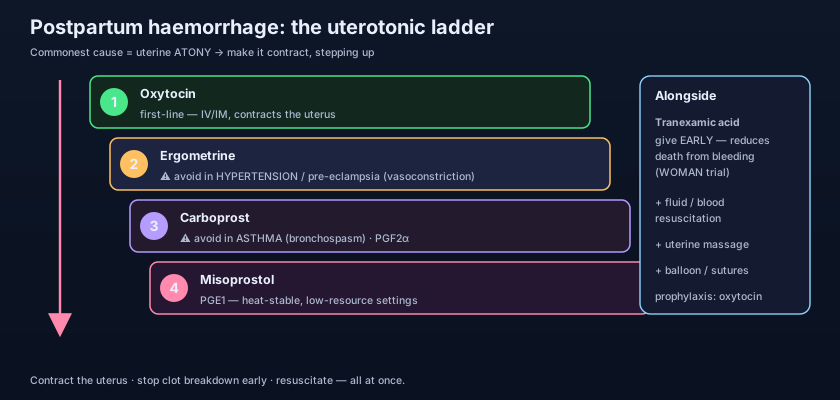
You climb one rung at a time, and each rung carries a contraindication you must know cold. Rung one is oxytocin, the same drug as prophylaxis but now used therapeutically — an IV bolus and/or a continuous infusion to drive sustained contraction. It is first-line because it works fast and is remarkably safe. Rung two is ergometrine, an ergot alkaloid that produces a strong, sustained uterine contraction lasting far longer than oxytocin. But ergot alkaloids are also vasoconstrictors — they raise blood pressure — which is why ergometrine is contraindicated in hypertension and pre-eclampsia. Giving it to a pre-eclamptic woman can spike her blood pressure dangerously, a classic and heavily examined trap; it also commonly causes nausea and vomiting. In practice ergometrine is often given combined with oxytocin as a fixed preparation (Syntometrine), pairing oxytocin's fast onset with ergometrine's long, firm hold.
Rung three is carboprost, a prostaglandin F2-alpha analogue given intramuscularly (or by direct intramyometrial injection) that powerfully contracts the uterus when oxytocin and ergometrine have failed. Its signature contraindication is asthma, because prostaglandin F2-alpha causes bronchoconstriction — carboprost can trigger severe bronchospasm, the mirror-image trap to ergometrine. It also commonly causes fever, flushing, and diarrhoea. Rung four is misoprostol, a prostaglandin E1 analogue given sublingually or rectally. It is less potent and slower than injectable uterotonics, but it has a decisive practical advantage: it is heat-stable and needs no refrigeration or injection, making it invaluable in low-resource settings where oxytocin's cold chain cannot be guaranteed. The prostaglandin agents — carboprost and misoprostol — connect to the Inflammation section, where prostaglandin biology and the bronchospasm link are taught in full.
1) Oxytocin — IV/IM, first-line, fast and safe; also the prophylactic drug. 2) Ergometrine — ergot alkaloid, long sustained contraction; AVOID in hypertension/pre-eclampsia (vasoconstrictor); causes vomiting; often combined with oxytocin as Syntometrine. 3) Carboprost — prostaglandin F2-alpha analogue, IM/intramyometrial; AVOID in asthma (bronchospasm); causes fever and diarrhoea. 4) Misoprostol — prostaglandin E1, sublingual/rectal; heat-stable, ideal for low-resource settings. Alongside the ladder: tranexamic acid given early, plus fluid and blood resuscitation. The two contraindications to memorize are the mirror pair — ergometrine not in hypertension, carboprost not in asthma.
- The commonest cause of primary PPH is uterine atony — the muscle fails to clamp the placental-bed vessels shut.
- The whole pharmacological aim is to make the uterus contract; clotting alone cannot stop atonic bleeding.
- Prophylaxis = routine oxytocin in active management of the third stage, roughly halving PPH risk.
- Treatment ladder: oxytocin → ergometrine → carboprost → misoprostol.
- Ergometrine is contraindicated in hypertension/pre-eclampsia; carboprost is contraindicated in asthma.
- Remember the four Ts of PPH: Tone, Tissue, Trauma, Thrombin — drugs treat Tone.
Stop the clot breakdown: tranexamic acid
Making the uterus contract is half the battle; the other half is protecting whatever clot does form. Tranexamic acid is an antifibrinolytic — it blocks the conversion of plasminogen to plasmin, the enzyme that dissolves fibrin clots, so clots are stabilized rather than broken down. The landmark WOMAN trial showed that giving tranexamic acid early reduces death from bleeding in postpartum haemorrhage, and it is now standard: given as soon as possible, ideally within the first three hours, because its benefit falls sharply with delay. This is the same drug, the same mechanism, used to stop trauma haemorrhage (the CRASH-2 trial) and to treat heavy menstrual bleeding — a thread that runs straight into the Haematology section on fibrinolysis and antifibrinolytics, and into the heavy menstrual bleeding chapter of this very section. One drug, three bleeding problems, one principle: stop the body from dissolving its own clots.
Two contraindications on the ladder are pure exam gold because they are mirror images. Ergometrine is a vasoconstrictor, so it is the wrong drug in the hypertensive or pre-eclamptic woman — the very patient a labour ward sees constantly. Carboprost is a bronchoconstrictor, so it is the wrong drug in the asthmatic. Memorize them as a pair: "ergometrine raises the pressure, carboprost closes the airway." When a vignette hands you a pre-eclamptic woman bleeding, skip ergometrine; when it hands you an asthmatic, skip carboprost — and the safe alternative on the ladder (oxytocin, or misoprostol) is usually the intended answer.
Beyond the drugs — and secondary PPH
Uterotonics do not act alone. From the first moment, the team resuscitates: large-bore access, warmed fluids, and blood products for major loss, guided by the ABC of any haemorrhage. Simple mechanical measures buy time and often work — firm uterine massage and bimanual compression physically squeeze the muscle while the drugs take hold. If the ladder and these measures fail, escalation is mechanical and surgical rather than pharmacological: an intrauterine balloon tamponade to press on the bleeding bed from inside, compression (brace) sutures such as the B-Lynch to squeeze the whole uterus, arterial ligation or embolization, and, as a last resort, hysterectomy. These are briefly noted here because this is a pharmacology chapter — but the principle to carry away is that drugs and resuscitation run in parallel, not in sequence: you never finish giving fluids before you start making the uterus contract.
Not all postpartum bleeding happens on the delivery table. Primary PPH is bleeding within the first 24 hours; secondary PPH occurs from 24 hours up to about six weeks postpartum. The mechanism — and therefore the treatment — is different. Secondary PPH is usually caused by retained products of conception or by endometritis (infection of the uterine lining), so the mainstay is antibiotics for the infection, often with a uterotonic to help the uterus contract and expel retained tissue, and sometimes surgical evacuation. The lesson is that the timing of the bleed points you toward its cause: a torrential bleed in the first hour is atony until proven otherwise and belongs on the uterotonic ladder; a bleed at two weeks with a tender uterus and offensive lochia is endometritis until proven otherwise and belongs on antibiotics.
- Tranexamic acid is an antifibrinolytic — it stabilizes clot by blocking plasminogen→plasmin; give it EARLY (WOMAN trial).
- Drugs and resuscitation run in parallel: fluids, blood, uterine massage, and the ladder all at once.
- If drugs fail, escalate mechanically/surgically: balloon tamponade, brace sutures, ligation, hysterectomy last.
- Primary PPH (<24 h) is usually atony; secondary PPH (24 h–6 weeks) is usually retained products/endometritis.
- Secondary PPH is treated with antibiotics ± a uterotonic, not primarily with the atony ladder.
- Giving ergometrine to a hypertensive or pre-eclamptic woman — its vasoconstriction can spike the blood pressure dangerously. Choose oxytocin or a prostaglandin instead.
- Giving carboprost to an asthmatic — prostaglandin F2-alpha causes bronchospasm and can precipitate a severe attack. Reach for oxytocin or misoprostol.
- Delaying or omitting tranexamic acid — its benefit depends on early administration, so waiting until bleeding is massive squanders it. Give it as soon as PPH is diagnosed.
A woman with severe pre-eclampsia develops brisk postpartum bleeding from a boggy, atonic uterus. Oxytocin has been given but bleeding continues. Which uterotonic is contraindicated as the next step?
- Primary PPH is most often uterine atony; the pharmacological aim is to make the uterus contract, and clotting alone cannot stop it.
- Prophylaxis is routine oxytocin in active management of the third stage; treatment climbs the ladder oxytocin → ergometrine → carboprost → misoprostol.
- Know the mirror contraindications: ergometrine avoided in hypertension/pre-eclampsia (vasoconstrictor), carboprost avoided in asthma (bronchospasm).
- Give tranexamic acid early to reduce death from bleeding (WOMAN trial), resuscitate in parallel, and treat secondary PPH (retained products/endometritis) with antibiotics ± a uterotonic.
- Rang & Dale's Pharmacology — Drugs affecting the uterus: oxytocin, ergometrine and prostaglandins.
- Katzung Basic & Clinical Pharmacology — Uterine-stimulant drugs (oxytocics) and antifibrinolytics.
- British National Formulary (BNF) — Postpartum haemorrhage: oxytocin, ergometrine/Syntometrine, carboprost, misoprostol, tranexamic acid.
- NICE — Intrapartum care and postpartum haemorrhage; RCOG Green-top Guideline No. 52, Prevention and Management of Postpartum Haemorrhage.
- WOMAN Trial Collaborators. Effect of early tranexamic acid administration on mortality in postpartum haemorrhage. The Lancet.
- WHO — Recommendations for the prevention and treatment of postpartum haemorrhage.