
Bacterial Conjunctivitis and the Ocular Antibiotic Toolkit
A red, sticky eye is one of the most common reasons a patient walks into a clinic — and one of the most over-treated. Most bacterial conjunctivitis clears on its own within a week or two; the antibiotic drops we reach for often just make everyone feel better about doing something. But hidden inside that same red eye are a handful of causes that are true emergencies — a gonococcal infection that can eat through a cornea in a day, a chlamydial infection that is a leading cause of blindness worldwide, and a contact-lens wearer whose "conjunctivitis" is actually Pseudomonas melting the cornea. The whole skill is knowing which red eye you're looking at, and which ones the drops cannot fix.
A 24-year-old comes to the walk-in clinic with a red, gritty right eye that was glued shut with yellow crust this morning. She wears monthly contact lenses and slept in them twice this week. On examination the eye is diffusely pink, the discharge frankly purulent, and — the detail that changes everything — there is a small white spot on the cornea that stains with fluorescein, and she flinches at the light. This is no longer simple conjunctivitis; a contact-lens wearer with a corneal infiltrate is Pseudomonas keratitis until proven otherwise, and that cornea can perforate. She is referred to ophthalmology the same day for intensive fortified antibiotic drops and a corneal scrape. Two chairs over, a mother waits with a three-day-old baby whose eyelids are swollen and pouring pus — another red eye entirely, and another emergency. Same complaint; two very different diseases.
The red eye: three common culprits
Before you reach for an antibiotic, decide what kind of red eye you're treating. Conjunctivitis — inflammation of the thin membrane covering the white of the eye and the inner lids — comes in three everyday flavours, and the discharge is your best clue. Bacterial conjunctivitis gives a thick, purulent, yellow-green discharge that re-glues the lids after wiping; it is usually one eye first. Viral conjunctivitis (most often adenovirus) is watery, often with a recent cold, a pre-auricular lymph node, and a gritty "foreign-body" feel; it is highly contagious and spreads to the other eye. Allergic conjunctivitis is dominated by itch — the symptom viral and bacterial disease lack — with stringy mucus, swollen "boggy" conjunctiva, and both eyes at once, in a patient with hay fever or eczema. Crucially, none of these three should threaten vision: true pain, marked photophobia, or reduced acuity means you are no longer dealing with simple conjunctivitis and must think of keratitis, uveitis or angle-closure — the red flags covered in the Red-eye differential, and alongside the Viral and Allergy chapters of this section.
The organisms behind ordinary bacterial conjunctivitis are predictable: Staphylococcus aureus and Streptococcus pneumoniae in adults, plus Haemophilus influenzae and Moraxella catarrhalis (and again Strep pneumoniae) commonly in children. This narrow, familiar list is why empirical broad-spectrum topical therapy works so well when treatment is actually needed — you rarely have to culture a simple case. The topical route matters here: because the conjunctiva and cornea are bathed directly, a drop delivers high drug concentrations right at the infected surface with minimal systemic absorption, a principle laid out in the Ocular pharmacology foundations chapter.
The topical antibiotic classes
A handful of drug classes cover almost every ocular-surface infection. Chloramphenicol is the workhorse first-line agent in many countries — broad-spectrum against Gram-positives and most Gram-negatives, cheap, and available over the counter as drops or ointment. It inhibits bacterial protein synthesis at the 50S ribosomal subunit. Its reputation carries an old shadow: systemic chloramphenicol can cause fatal aplastic anaemia, and this fear was extended to the eye drops. In reality the ocular dose is minuscule and the risk, if it exists at all, is vanishingly rare and unproven — decades of use have not established a causal link, and topical chloramphenicol remains first-line where it is licensed. Aminoglycosides — gentamicin and tobramycin — bind the 30S ribosomal subunit and add strong Gram-negative cover, useful when Gram-negatives are suspected. Fluoroquinolones — ciprofloxacin, ofloxacin, levofloxacin and moxifloxacin — inhibit bacterial DNA gyrase/topoisomerase, give the broadest cover including Pseudomonas, and are reserved for more serious disease such as keratitis rather than trivial conjunctivitis, to preserve them against resistance. These class mechanisms are taught in full in the Antimicrobials section.
Three more agents round out the toolkit. Macrolides — erythromycin ointment and azithromycin drops — inhibit the 50S subunit, cover Gram-positives and are gentle enough for neonates and for chlamydial surface disease (though chlamydia also needs systemic treatment — more on that below). Fusidic acid is narrow-spectrum but excellent against Staphylococcus, comes as a viscous gel that suits twice-daily dosing, and is a common choice in staphylococcal blepharitis-associated conjunctivitis. Polymyxin B is almost always found in combination drops — classically polymyxin B with trimethoprim, or with bacitracin/neomycin — where polymyxin disrupts the Gram-negative outer membrane and its partner covers the Gram-positives. Note that neomycin (an aminoglycoside) is a frequent cause of contact allergy, so a conjunctivitis that worsens on a neomycin-containing drop may be reacting to the treatment itself.
Think of the ocular antibiotics like a set of house keys of different reach. Chloramphenicol is the master key that opens most ordinary doors — you grab it first for the everyday lock. Fusidic acid is the narrow key cut specifically for the Staph door. The aminoglycosides add the key to the Gram-negative back door. And the fluoroquinolones are the locksmith's skeleton key that opens almost everything, including the Pseudomonas vault — precisely why you keep it in your pocket for the serious jobs rather than using it to open the front door every day.
Ointment or drops?
The same antibiotic behaves differently depending on its vehicle. Drops are easy to instil and don't blur vision, but they wash out in tears within minutes, so they need frequent dosing — often every two to four hours in active infection. Ointment stays in contact with the ocular surface far longer, giving sustained release from a lipid reservoir and needing only two or three applications a day, which improves adherence. The trade-off is that ointment smears across the cornea and blurs vision for several minutes after application. That single fact dictates practice: ointment is ideal at bedtime (blurring doesn't matter while asleep and the drug works through the night) and in young children who won't tolerate frequent drops, while drops suit the daytime and anyone who needs to see clearly and drive.
- Discharge sorts the red eye: purulent = bacterial, watery = viral, itchy/stringy = allergic.
- Simple bacterial conjunctivitis should NOT reduce vision or cause true pain — those are red flags.
- Chloramphenicol = broad-spectrum first-line; the aplastic-anaemia risk from drops is theoretical/unproven.
- Aminoglycosides add Gram-negative cover; fluoroquinolones are broadest (incl. Pseudomonas) — reserve for keratitis.
- Ointment lasts longer and needs fewer doses but blurs vision — ideal at night and in children.
- Most simple bacterial conjunctivitis is self-limiting — antibiotics only speed a cure that would come anyway.
The high-stakes causes: when topical is not enough
A few red eyes are systemic diseases wearing a conjunctivitis mask. Hyperacute purulent conjunctivitis — a dramatically red eye with copious, rapidly re-accumulating pus developing over hours, not days — is Neisseria gonorrhoeae until proven otherwise, and it is a true ophthalmic emergency. Gonococcus is one of the very few organisms that can penetrate an intact corneal epithelium, so it threatens rapid corneal ulceration and perforation. Topical antibiotics alone are inadequate: treatment is systemic ceftriaxone (with corneal involvement treated as disseminated disease), saline irrigation of the pus, and treatment of sexual partners. Chlamydia trachomatis is the other great mimic. In adults it causes a chronic, follicular "inclusion" conjunctivitis — a red eye that grumbles on for weeks and doesn't respond to ordinary drops — while repeated childhood infection causes trachoma, scarring the lids so the lashes turn inward and abrade the cornea, and it remains a leading infectious cause of blindness worldwide. Chlamydia lives inside cells and cannot be cleared by topical therapy alone: it needs systemic azithromycin (a single oral dose) or a course of doxycycline, and again, partner treatment. The mechanistic reasons these particular drugs are chosen are set out in the Antimicrobials section.
The newborn eye is its own emergency. Ophthalmia neonatorum — conjunctivitis in the first month of life — is most dangerously caused by the same two sexually transmitted organisms acquired during birth. Gonococcal ophthalmia appears hyperacute in the first few days and, as in adults, can perforate the cornea; chlamydial ophthalmia appears a little later, around the end of the first week. Both are treated systemically, not with drops alone — systemic ceftriaxone for gonococcal, systemic (oral) erythromycin or azithromycin for chlamydial, which also treats the associated risk of chlamydial pneumonia. This is why prophylaxis at birth and screening of pregnant mothers matter so much. And separately: any contact-lens wearer with a red, painful eye is assumed to have Pseudomonas keratitis until proven otherwise — an infection of the cornea itself, not the conjunctiva, that needs intensive fortified or fluoroquinolone drops and urgent ophthalmology review. That scenario is covered in depth in the Keratitis chapter.
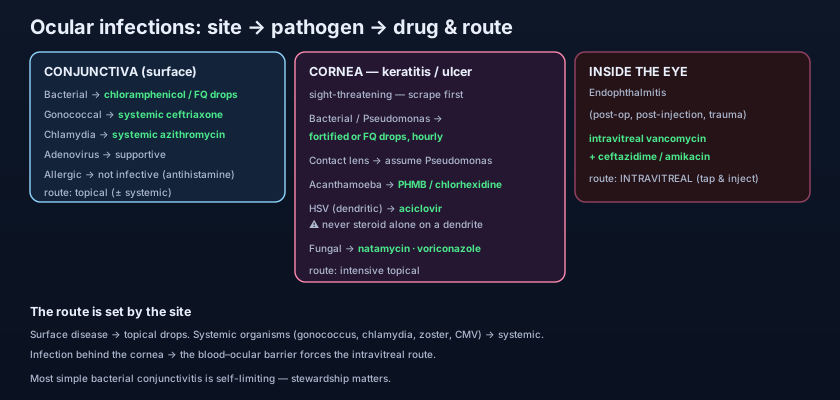
The single most useful reflex in this whole topic: match the treatment route to where the bug lives. A bug sitting on the ocular surface (ordinary Staph/Strep/Haemophilus conjunctivitis) is reachable by a drop. A bug that penetrates the cornea (gonococcus), hides inside cells (chlamydia), or is really a corneal or intraocular infection wearing a red-eye disguise cannot be reached by drops alone and needs systemic — or intravitreal — therapy. When a "conjunctivitis" is hyperacute, chronic and unresponsive, in a neonate, or in a contact-lens wearer, ask whether topical is genuinely enough — because in those four situations it usually is not.
Chloramphenicol (drops + ointment): broad-spectrum first-line for simple conjunctivitis. Fusidic acid (gel): narrow, anti-staphylococcal, twice daily. Aminoglycosides — gentamicin, tobramycin: added Gram-negative cover. Fluoroquinolones — ciprofloxacin, ofloxacin, moxifloxacin: broadest, cover Pseudomonas, reserved for keratitis/serious disease. Macrolides — erythromycin ointment, azithromycin drops: Gram-positive, neonate-friendly, adjunct in chlamydia. Polymyxin B combinations (with trimethoprim or bacitracin): the polymyxin covers Gram-negatives. And the systemic exceptions that topical cannot replace: ceftriaxone (gonococcal), azithromycin or doxycycline (chlamydial/trachoma), oral erythromycin (neonatal chlamydia).
- Hyperacute purulent conjunctivitis = gonococcus: an emergency, needs SYSTEMIC ceftriaxone (can perforate the cornea).
- Chronic follicular conjunctivitis = chlamydia: needs SYSTEMIC azithromycin/doxycycline; trachoma is a top global blindness cause.
- Ophthalmia neonatorum (gonococcal/chlamydial) is treated systemically — plus prophylaxis and maternal screening.
- Contact-lens wearer + red painful eye = Pseudomonas keratitis until proven otherwise — urgent referral.
- Route follows the pathogen's location: surface bug → drop; invasive/intracellular/deep bug → systemic or intravitreal.
- Treating gonococcal or chlamydial conjunctivitis with topical drops alone — both need systemic antibiotics (ceftriaxone; azithromycin/doxycycline) and partner treatment.
- Dismissing a contact-lens wearer's red eye as "just conjunctivitis" — a corneal infiltrate is Pseudomonas keratitis and can perforate.
- Reflexively prescribing antibiotics for every red sticky eye — most simple bacterial conjunctivitis is self-limiting, and stewardship matters.
A 3-day-old neonate develops markedly swollen lids with copious purulent discharge from both eyes over 24 hours. Gram stain of the discharge shows Gram-negative intracellular diplococci. What is the most appropriate management?
- The red eye splits by discharge: purulent bacterial, watery viral, itchy allergic — and simple conjunctivitis never threatens vision.
- Topical toolkit: chloramphenicol (broad first-line; aplastic-anaemia risk theoretical), aminoglycosides (Gram-negative), fluoroquinolones (broadest, reserve for keratitis), macrolides, fusidic acid (Staph), polymyxin combinations.
- Ointment lasts longer but blurs vision (best at night/children); drops need frequent dosing but keep vision clear.
- Know the systemic exceptions: gonococcal (ceftriaxone), chlamydia/trachoma (azithromycin/doxycycline), ophthalmia neonatorum, and contact-lens Pseudomonas keratitis — topical alone is not enough.
- Kanski's Clinical Ophthalmology: A Systematic Approach — Conjunctiva and Cornea (infective conjunctivitis, keratitis).
- Bartlett & Jaanus, Clinical Ocular Pharmacology — Antibacterial agents and the treatment of ocular infection.
- American Academy of Ophthalmology, Basic and Clinical Science Course (BCSC) — External Disease and Cornea; Fundamentals and Principles of Ophthalmology.
- American Academy of Ophthalmology, Preferred Practice Pattern — Conjunctivitis.
- NICE Clinical Knowledge Summaries — Conjunctivitis (infective); and BNF, Eye chapter (anti-infective eye preparations).
- World Health Organization — Trachoma and the SAFE strategy; Rang & Dale's Pharmacology — Antibacterial drugs.

