
Dry Eye Disease: Tears, Inflammation and the Ocular Surface
Dry eye sounds trivial — a dose of drops and be done with it. It is anything but. It is one of the commonest reasons a patient ever walks into an eye clinic, and it is one of the most quietly instructive stories in ocular pharmacology: a self-perpetuating vicious cycle that no single drop can break, treated by a ladder that climbs from simple lubricants all the way to drugs that switch off T cells on the surface of the eye. Learn dry eye and you learn how modern ophthalmology thinks — that the tear film is not just water, and that the real disease is inflammation.
A 58-year-old woman has been to three pharmacies in a month. Her eyes feel gritty, as if there is sand under the lids, worse by evening and worse still after an afternoon of screen work. Paradoxically, they water — tears spill down her cheeks, which makes no sense to her for eyes she has been told are "dry." She has tried a different bottle of drops each week and each one helps for twenty minutes. On the slit lamp her tear film breaks up almost the instant she stops blinking, the lid margins are thickened with capped, plugged glands, and the surface stains in fine speckles where cells have been lost. She does not need a fourth kind of drop. She needs someone to see that her tear film is unstable, her glands are blocked, and the surface underneath is inflamed — and to treat all three.
The tear film is three layers, not one
What sits on the front of the eye is not a pool of water — it is a precisely engineered three-layer sandwich. From the surface outward: an oily lipid layer, secreted by the meibomian glands in the eyelid margins, floats on top and stops the tears evaporating. Beneath it, the thick aqueous layer, produced by the lacrimal glands, carries water, salts, antibodies and oxygen. Anchoring everything to the eye is the mucin layer, made by goblet cells scattered through the conjunctiva, which turns a water-repelling cornea into a wettable surface the tears can spread evenly across. The three depend on each other completely: lose the oil and the water evaporates; lose the mucin and the water beads up and runs off. A stable tear film needs all three intact — which is exactly why dry eye has more than one cause.
Two types that meet at the same place
Dry eye splits into two overlapping types. Aqueous-deficient dry eye means the lacrimal glands simply do not make enough water — the classic cause is Sjögren's syndrome, where autoimmune inflammation destroys the glands, but ageing, and many drugs, do the same. Evaporative dry eye means the tears are made but boil off too fast because the oily layer is faulty — and its overwhelming cause is meibomian gland dysfunction (MGD), where the lid glands clog and stop delivering healthy oil. Evaporative disease is by far the commonest, and most patients in fact have a mixture of both. The crucial idea is that whichever door you come in by, the two paths converge on a single final common mechanism: the tears become too salty.
The engine of the disease: hyperosmolarity and inflammation
Whether too little water is made or too much evaporates, the tears left behind are concentrated — and salt on a living surface is an irritant. This is the central insight of modern dry-eye pharmacology. Reduced volume or excess evaporation both raise the salt concentration of the tears — tear hyperosmolarity — and a hyperosmolar film is toxic to the epithelial cells of the cornea and conjunctiva. The stressed cells release inflammatory signals; T cells are recruited to the ocular surface; goblet cells are lost so even less mucin is made; and the inflamed, damaged surface produces a still less stable tear film that becomes more hyperosmolar yet. That is the vicious cycle: hyperosmolarity drives inflammation, inflammation drives instability, instability drives more hyperosmolarity. The disease feeds itself. And this reframes everything — because a cycle powered by inflammation cannot be broken for good by simply adding water. Sooner or later you have to switch the inflammation off. The T-cell biology here is a direct cousin of the immunology taught in the Inflammation & Joints section.
Think of the tear film like the paint on a car left in a hot car park. The clear coat of wax on top — that is the oily meibomian layer — stops the water beneath from baking off. Blockage of the wax glands is like scratching that coat away: the water underneath evaporates fast, minerals concentrate and etch the paint (the surface cells), and once the paint is damaged it holds the next film even more poorly. Topping up with water alone is like hosing the car every ten minutes — it helps for a moment, but the real fix is restoring the wax layer and stopping the etching. In dry eye, "stopping the etching" is treating the inflammation.
Drugs that dry the eye
Before reaching for treatment, ask what the patient is already taking — because a long list of systemic drugs cause or worsen dry eye, and stopping the culprit can be the best therapy of all. Anything anticholinergic reduces lacrimal secretion: the tricyclic antidepressants, older antihistamines, oxybutynin for the bladder, and the antimuscarinics used in Parkinson's. First-generation antihistamines for allergy are notorious for it. Isotretinoin, given for severe acne, shrinks and disables the meibomian glands and is a classic cause of evaporative dry eye. Systemic beta-blockers, diuretics and hormone therapy are all associated. And a subtle self-inflicted one: the preservative benzalkonium chloride (BAK) in the very eye drops patients use for glaucoma or allergy is toxic to the surface epithelium, so chronic preserved drops can themselves drive dry eye — the reason preservative-free preparations matter so much. This whole theme belongs to the Systemic-effects chapter, which catalogues the drugs whose side effects show up in the eye.
- The tear film has three interdependent layers: lipid (meibomian), aqueous (lacrimal), mucin (goblet cells).
- Two overlapping types: aqueous-deficient (Sjögren's, age, drugs) and evaporative (MGD — the commonest).
- Both converge on tear hyperosmolarity → ocular-surface inflammation → damage — a self-perpetuating vicious cycle.
- Because inflammation drives the cycle, adding water alone cannot cure moderate–severe disease.
- Drug causes: anticholinergics, first-gen antihistamines, isotretinoin, beta-blockers, and preserved (BAK) drops.
The treatment ladder, step by step
Management is a ladder: start simple, climb only as far as severity forces you. Step one is artificial tears — lubricant drops for daytime, thicker gels for heavier symptoms, and ointments at night when blurring does not matter. The single most important prescribing rule here is to prefer preservative-free preparations for anyone dosing more than about four times a day, because the BAK in preserved drops would otherwise poison the surface you are trying to heal. Step two treats the lids and meibomian glands directly, since evaporative disease is so common: warm compresses and lid hygiene to melt and express the clogged oil, and — importantly for a pharmacology course — a course of oral tetracyclines (doxycycline) or azithromycin, used not as antibiotics but for their anti-inflammatory and lipid-normalising effect on the meibomian glands. That dual role links to the Antimicrobials section, where these same agents appear as antibiotics, and to the Inflammation section, where tetracycline's anti-inflammatory action is explained.
Step three keeps precious tears on the eye longer by blocking their drainage: punctal plugs, tiny inserts placed in the tear-drainage puncta so what little tear film there is stays on the surface instead of draining down the nose. Step four is the true anti-inflammatory tier, reserved for moderate-to-severe disease that lubricants and lid care cannot control — the point where you stop merely supplementing the tears and start treating the underlying inflammation. Topical ciclosporin (a calcineurin inhibitor that suppresses the surface T cells and lets the lacrimal glands recover) and topical lifitegrast (an LFA-1 antagonist that blocks a T-cell adhesion signal, cutting inflammatory cells off at the surface) are the two mainstays; both act on the immune cycle rather than the water. For rapid control of a severe flare, a short pulse of a topical corticosteroid calms the surface quickly — but only briefly, always with the usual steroid caveats. For the most severe surface disease, autologous serum drops — eye drops made from the patient's own blood serum, rich in the growth factors normal tears contain — help the epithelium heal. Step five reaches for secretagogues and newer agents.
The newest rungs are worth knowing because they attack the disease from fresh angles. Varenicline nasal spray is a nicotinic receptor agonist sprayed in the nose to stimulate the trigeminal-parasympathetic reflex that drives natural tearing — the body making its own complete tear film rather than a substitute dripped on from outside. And perfluorohexyloctane is a water-free, preservative-free drop that spreads as a thin film to slow evaporation, aimed specifically at evaporative dry eye and meibomian gland dysfunction. Both illustrate the direction of travel: away from just topping up water, toward restoring the eye's own tear physiology and controlling the surface.
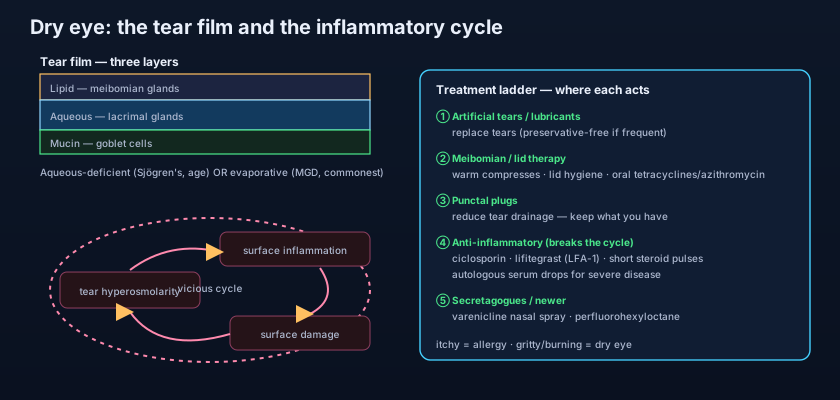
- Step 1 — artificial tears (drops/gels/ointments); prefer preservative-free for frequent use.
- Step 2 — treat the lids/meibomian glands: warm compresses, lid hygiene, oral tetracyclines/azithromycin (anti-inflammatory role).
- Step 3 — punctal plugs reduce tear drainage and keep the film on the eye longer.
- Step 4 — anti-inflammatory therapy: topical ciclosporin, lifitegrast (LFA-1 antagonist), short-pulse steroids, autologous serum.
- Step 5 — secretagogues and newer agents: varenicline nasal spray, perfluorohexyloctane for evaporative disease.
- Always screen for and stop drying culprit drugs before escalating therapy.
The paradox of the watering dry eye trips up students and patients alike. An eye whose tear film is unstable and whose surface is irritated triggers a reflex flood of watery tears — but reflex tears are poor quality, lack the oily and mucin components, and drain straight away, so they soothe nothing. Watering is therefore a classic symptom of dry eye, not evidence against it. Prescribe lubricants to a "watering" eye and it can be exactly the right call.
The single most useful question at the slit lamp is: does it itch, or does it feel gritty? Itch is the signature of ocular allergy — a histamine-driven, watery, itchy eye that responds to antihistamine/mast-cell-stabiliser drops. A gritty, foreign-body, burning sensation, worse through the day and with screen use, is the signature of dry eye. The two overlap and can coexist, and interestingly both can be treated with topical ciclosporin at the severe end — chronic allergic surface disease (such as vernal or atopic keratoconjunctivitis) is another place ciclosporin earns its keep. The allergy side of this story is told in full in the Ocular allergy chapter.
Dry eye is sometimes the first visible sign of a systemic autoimmune disease. Severe aqueous-deficient dry eye should always prompt the question of Sjögren's syndrome, an autoimmune disease that destroys the exocrine glands and classically presents with the triad of dry eyes, dry mouth, and an associated connective-tissue disease such as rheumatoid arthritis or lupus. It matters because the eye may be the presenting complaint of a condition that needs systemic diagnosis and management — the reason ciclosporin, T-cell immunology and Sjögren's are threaded through the Inflammation & Joints section. A young woman with unrelenting dry eye and a dry mouth needs more than lubricants; she needs a rheumatology work-up.
- Treating a "watering" eye as never being dry — reflex tearing from an unstable film is a hallmark of dry eye, and lubricants are often the right answer.
- Prescribing frequent preserved drops long-term — the BAK preservative is toxic to the surface epithelium and can worsen the very disease you are treating; go preservative-free.
- Chasing symptoms with ever more lubricant while ignoring the blocked meibomian glands and the underlying inflammation — moderate–severe disease needs lid therapy and anti-inflammatory treatment, not just water.
A 60-year-old on multiple preserved glaucoma drops has moderate dry eye with gritty burning, unstable tear film and blocked meibomian glands, not controlled by frequent preserved artificial tears. Which change is the single most appropriate next step?
- The tear film has three interdependent layers — lipid (meibomian), aqueous (lacrimal), mucin (goblet cells); losing any one destabilises it.
- Two overlapping types — aqueous-deficient (Sjögren's, age, drugs) and evaporative (MGD, the commonest) — converge on tear hyperosmolarity → surface inflammation → a vicious cycle.
- Treatment climbs a ladder: artificial tears (preservative-free) → lid/meibomian therapy + oral tetracyclines/azithromycin → punctal plugs → anti-inflammatories (ciclosporin, lifitegrast, short-pulse steroids, autologous serum) → secretagogues/newer agents.
- Watching for drying culprit drugs and for Sjögren's, and remembering the itchy-allergic vs gritty-dry distinction, is as important as the drops themselves.
- Kanski's Clinical Ophthalmology: A Systematic Approach — Dry eye disease and the ocular surface.
- Bartlett & Jaanus, Clinical Ocular Pharmacology — Dry eye and lubricants; anti-inflammatory therapy.
- American Academy of Ophthalmology, Basic and Clinical Science Course (BCSC) — External Disease and Cornea.
- TFOS DEWS II Report (Tear Film & Ocular Surface Society, Dry Eye Workshop II) — definition, pathophysiology and management.
- Rang & Dale's Pharmacology — immunosuppressants (ciclosporin) and anti-inflammatory agents.
- BNF and Royal College of Ophthalmologists guidance — management of dry eye disease.