
Inhalers & Devices: Getting the Drug to the Lungs
The best asthma drug in the world is useless if it never reaches the lungs — and studies show a large fraction of patients use their inhaler wrong. This is the most practical topic in respiratory medicine: knowing the device types, why a spacer helps so much, and the small habits that make the difference between a drug that works and one that doesn't.
Here's a fact that surprises people: when an asthma inhaler seems to 'stop working', the commonest reason isn't the drug at all — it's that the patient isn't using the device properly, so the medicine ends up in the mouth and throat instead of deep in the lungs. Inhaler technique is genuinely one of the most important and most neglected skills in medicine. Since the whole point of respiratory drugs is to deliver them straight to the airways (from the last article), how you deliver them is half the battle. There are a handful of device types, each solving a particular problem, and understanding what each one is for makes prescribing and teaching them straightforward.
The device types
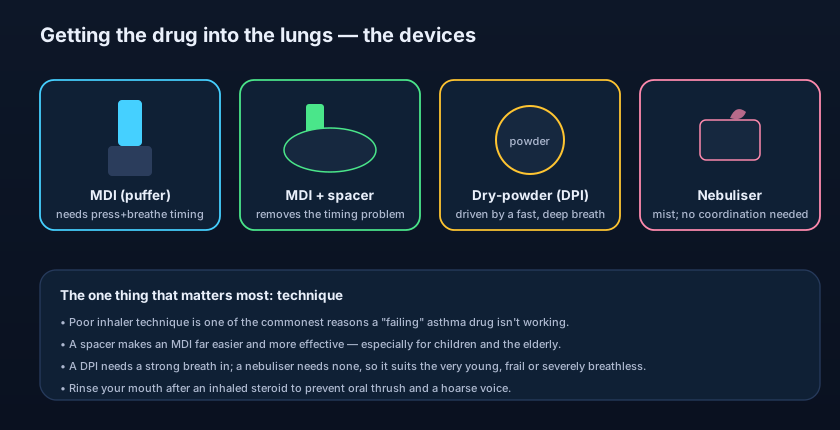
Each device solves a different delivery problem. The classic device is the pressurised metered-dose inhaler (MDI) — the familiar 'puffer' that sprays a measured dose when pressed. Its weakness is that it demands coordination: you must press and breathe in slowly at exactly the same moment, and many people can't, so the dose hits the back of the throat and is wasted. The fix for that is a spacer — a plastic chamber that clips onto the MDI. You spray the dose into the chamber and then breathe from it at your own pace, which removes the timing problem entirely and delivers far more drug to the lungs. Spacers are especially valuable for children, the elderly, and anyone who struggles with coordination. A different design is the dry-powder inhaler (DPI), which contains the drug as a powder and needs no coordination — but instead requires the patient to take a fast, deep breath in to pull the powder into the lungs, so it doesn't suit those too weak or too breathless to inhale forcefully. Finally, the nebuliser turns liquid drug into a fine mist breathed in over several minutes through a mask; it needs no technique or coordination at all, so it's used for the very young, the very frail, or someone in a severe attack who can't manage a handheld device.
The habits that make it work
A few simple habits separate an inhaler that works from one that doesn't. First and most important: check technique, again and again. Poor technique is so common that whenever an inhaled drug 'isn't working', the first thing to do is watch the patient use it — often the problem is fixed by correcting how they breathe, or by adding a spacer, not by changing the drug. Second, there's one habit specific to inhaled steroids: rinse your mouth and spit after using them. Because the steroid coats the mouth and throat on its way down, leaving it there can cause a fungal infection (oral thrush) and a hoarse voice — both local side effects, and both easily prevented by rinsing. (This, incidentally, is why a spacer also reduces thrush — less drug is left in the mouth.) Third, teach patients to know their inhalers by role, not just colour: which is the reliever to grab when breathless, and which is the daily controller. Getting the device and the technique right is not a minor detail — it is often the difference between controlled and uncontrolled disease.
- MDI ('puffer') needs press-and-breathe coordination; poor technique wastes the dose in the mouth.
- A spacer removes the timing problem and boosts lung delivery — great for children and the elderly.
- A DPI needs a fast, deep breath (no coordination); a nebuliser needs no technique at all.
- When an inhaled drug 'fails', check technique FIRST before changing the drug.
- Rinse the mouth after an inhaled steroid to prevent oral thrush and hoarse voice.
The single highest-yield habit in all of respiratory care is almost embarrassingly simple: before you ever escalate the treatment, watch the patient use their inhaler. So many 'treatment failures' are really device failures — the drug is fine, but it's landing on the tongue instead of in the lungs. Adding a spacer or correcting the breathing technique fixes more asthma than most dose increases do. It's a humbling reminder that in medicine, choosing the right drug is only half the job; making sure it actually reaches its target is the other half, and it's the half most often forgotten.
- Escalating the drug before checking inhaler technique — the device is often the real problem.
- Not offering a spacer to a child or elderly patient using an MDI.
- Prescribing a DPI to someone too breathless or weak to inhale forcefully.
- Forgetting to tell steroid-inhaler users to rinse their mouth — thrush and hoarseness.
An asthma inhaler seems to have 'stopped working'. What should you check first?
- MDI needs coordination; a spacer fixes that and boosts lung delivery (ideal for kids/elderly).
- DPI needs a strong breath; nebuliser needs no technique — for the frail or severely breathless.
- When an inhaled drug 'fails', check technique first — it's the commonest cause.
- Rinse the mouth after inhaled steroids to prevent thrush and hoarseness.
- Katzung BG. Basic & Clinical Pharmacology — Drugs Used in Asthma (delivery devices).
- Brunton LL, et al. Goodman & Gilman's The Pharmacological Basis of Therapeutics — Pulmonary drug delivery.
- GINA — Global Initiative for Asthma (inhaler technique & devices).
- Rang HP, Dale MM, et al. Rang & Dale's Pharmacology — Drug administration to the lungs.